I've been thinking over the whole Deepwater Horizon/Macondo/Moratorium mess and here are a few thoughts.
The Long-string vs. liner tieback issue made no difference in the blowout and the number of centralizers had very little effect, BUT the entire episode is very illustrative of BP's management. Time and time again, BP was putting things together at the last second with little oversight on the big picture.
BP's internal emails are the most illustrative of the anarchy that reigned in BP's organization:
-------
"One of BP‘s top cement experts also described ―the typical Halliburton
profile‖ as ―operationally competent and just good enough technically to get by." - Ref. (PDF)
-------
“Are you going to fire me?” - Ref.
-------
You seem to love being the victim. Everything is someone else’s fault. You criticize nearly everything we do on the rig but don’t seem to realize that you are responsible for every(thing) we do on the rig.
You seem to think that running is more important that well control.
... (Sims, the only BP engineer with a PE, to John Guide*, - Ref.
-------
Out of all those emails, though, this pair takes the cake:
---
I believe there is a bladder effect on the mud below an annular preventer as we discussed. As we know the pressure differential was approximately 1400-1500 psi across an 18 ¾″ rubber annular preventer, 14.0 SOBM plus 16.0 ppg [pounds per gallon] Spacer in the riser, seawater and SOBM below the annular bladder. Due to a bladder effect, pressure can and will build below the annular bladder due to the differential pressure but cannot flow – the bladder prevents flow, but we see differrential pressure on the other side of the bladder.
Now consider this. The bladder effect is pushing 1400-1500 psi against all of the mud below, we have displaced to seawater from 8,367′ to just below the annular bladder where we expect to have a 2,350 psi negative pressure differential pressure due to a bladder effect we may only have a 850-950 psi negative pressure until we lighten the load in the riser.
When we displaced the riser to seawater, then we truly had a 2,350 psi differential and negative pressure. - Robert Kaluza, BP Night Company Man on the Deepwater Horizon who was on duty when the well blew, explaining the "bladder effect"
---
Mike,
?????????????????????????????????????????
?????????????????????????????????????????
?????????????????????????????????????????
?????????????????????????????????????????
?????????????????????????????????????????
?????????????????????????????????????????
?????????????????????????????????????????
?????????????????????????????????????????
?????????????????????????????????????????
????????????????????
Regards,
Pat - response by Patrick O'Bryan, Drilling VP for BP North America - Ref.
-------
When everyone was trying to get off the rig to safety, nobody had a knife to cut the painter line that connected the liferaft to the rig. The liferaft was tethered to a sinking ship, nobody could find the safety knife on the raft, and BP's "Strict No-Knife Policy" was the only corporate policy of BP's that actually worked. There have been stabbings offshore (there are some surly characters offshore), but the "Strict No-Knife Policy" is typical big company bullshit that needs to stop. Every time I've been offshore, I've had a knife on hand (Leatherman Wave).
Another thing that's disgusted me: according to the testimony of multiple individuals, the USCG-certified Master on the Horizon told other crewmembers to leave an injured man behind on the rig before he jumped into the waters alone. No way to put it nicely; that was pretty shitty on his part and I have a feeling the Coasties will string his ass up for it.
Fortunately, a few things DID actually work. There were a few individuals who really stuck their neck out, for example, the Chief Mate (who kept one of the lifeboats on the rig until it was full to capacity, despite howling protests of those already inside) and the Chief Electrician (who, along with others, rescued the injured man mentioned above and kept his liferaft from drifting into the fire).
The US-flagged M/V Damon Bankston crew really are heroes. The more and more I read about the incident, the more I'm convinced that if it weren't for their quick response, there would be more than 11 dead. The Damon Bankston also had one INCREDIBLY important tool the Deepwater Horizon lacked: a fast rescue craft. The Deepwater Horizon tagged one of their large, slow, ungainly 75-man lifeboats as their "rescue craft" (in case of man overboard, etc.). The Damon Bankston had a dedicated, quick-launching, high performance (several hundred horsepower in a tiny craft) FRC that was also capable of rescuing incapacitated swimmers in rough waters** (a capability the Deepwater Horizon lacked). Every offshore platform I've ever been on has had a FRC (and all were constructed before the Deepwater Horizon). Now, there are some differences in a platform and a DP-rig, but still, the Horizon SHOULD have been designed with a FRC, in my professional opinion.
The US Coast Guard also blasted the flag-state of the Marshall Islands for lax enforcement of standards (which also turned out to have a few holes in them). The "flags of convenience" (nicknamed "Flags of Corporate Convenience") concept has never really set well with me. What I also don't like is there's been a push to drop Panama, who has slightly increased their regulatory requirements, for countries with even less regulation. I'm especially appalled by the idea of landlocked countries (like Mongolia) regulating merchant ships. The Russians and the Chinese lately seem to like Bolivia and Mongolia for some of their merchant ships. It just doesn't seem right to have a Marshall Islands-flagged ship sitting in US waters, when the ship was had never operated outside US waters and would NEVER operate in Marshall Islands territory. Note there's a USCG-led QUALSHIP initiative to up the standards on Flags of Convenience, but I'm not sure how effective it has been. Why not just use US-flagged drilling vessels (or at least require 30% or so of them be US-flagged)? I can name at least 1 modern US-flagged deepwater drilling rig in operation.
The qualifications of the DNV experts called in to investigate the BOP vs. the qualifications of BP's experts called in to knock the DNV BOP report was interesting. The DNV experts had an incredibly impressive resume. One of the leaders had a PhD in Materials Science and Engineering from Vandy and the other leader worked on the King's Cross Investigation. The King's Cross fire was a fairly standard trash fire that suddenly and unexpectedly flashed over and killed 31 people. The ins and outs of why was new to science (the Trench Effect, related to the Coandă effect) and it was even written up in my Fluid Dynamics textbook in college. It was literally an investigation so thorough it rewrote the textbooks. BP on the other hand put up one guy who had 'a year or two of engineering school before dropping out and working on rigs for 30+ years.' The expert was also a longtime contractor, not an actual BP employee. BP's expert completely flubbed basic materials science questions (that any senior in engineering could answer) to the point where the board stopped asking him questions. The BP expert wasn't a moron and he did have some interesting points about the DNV report, but nothing that undermined the DNV report in any significant way.
The damage thus far from the Moratorium has been greatly exaggerated, but I'll still be waiting to see what happens a few years down the line. A lot of these big deepwater projects have years-long lead times. Also, note that not every permit was actually drilled in the past and there always been a flow and ebb tide with drilling. Somedays, the rig count is high and rig dayrates are on the rise. Sometimes, everyone packs up and heads somewhere else or stacks the rigs in storage. I will say that the biggest benefit of US offshore oil isn't necessarily the jobs or the tax revenue (although those are important), but the effect on the Balance of Payments. Petroleum purchases are a HUGE portion of the US trade deficit and a big drag on the dollar (on the same level as the budget deficit?). Petroleum purchases are so huge, you often see disclaimers like 'non-petroleum trade deficit' in the fine print of charts in the WSJ, etc.
There's a quote in one of my favorite engineering disasters books, Inviting Disaster by Chiles. It goes something like 'operating on the cutting edge of technology is privilege conveyed on high-tech industries and those industries must protect and nourish that trust if they expect to stay in business and not have their franchise closed after too many failures dumped in societies lap.'*** That's a lesson the offshore industry must heed, or face the consequences. More costly errors and near misses cannot continue.
______________
* The de facto leader on the Macondo well. Some video of John Guide testifying here.
** Note that the waters were completely calm the night of the blowout, but the Damon Bankston did have to fish out incapacitated swimmers, a capability the Deepwater Horizon's lifeboats would have been unable to perform alone.
*** It's near the end of the book. I loaned out my copy right now, so I can't nail it word for word at the moment, but I'm sure that's the gist of it.
Monday, May 30, 2011


Thursday, May 26, 2011
Guilty, Guilty, Guilty
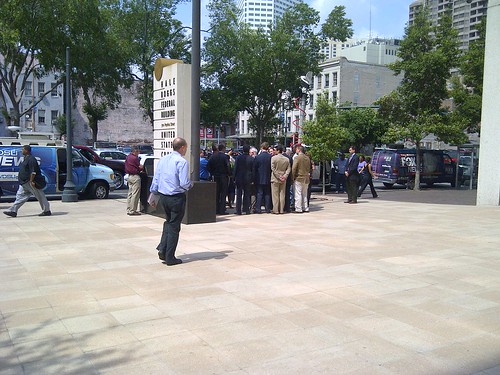
I got the opportunity to be in the courtroom today. I was a little late for the reading of the verdict.
I've been thinking about it and the one thing that still makes me a little sad: out of everything Meffert, Nagin, and St. Pierre did, nothing was more evil than the Interoperability Grant.
One thing we learned from the I-35W Bridge Collapse was what a difference a good, interoperable communications system can make. Despite the fact a damned interstate fell into the Mississippi and dozens were in danger, only 13 people died. Dozens were swiftly rescued from the water by adept, well-coordinated rescue work. Minnesota had the system that New Orleans lacked after Katrina.
Of all the charges today, not a single one related to the Interoperability Grant. In all likelyhood, nobody will ever to go to jail for it. Think of the lives in Katrina that could have been saved.
Saturday, May 14, 2011
"On the websites"

In honor of C-Ray:
Labou via Hulu.
Note C-Ray's speech at about 1:24-1:25 or so.
"...and I would have gotten away with it, too, if it hadn't been for you meddling kids!"
Check out AZ for the juicy details from the St. Pierre trial. Some of the best blogging I've ever read.
UPDATE- Much more to read at my new favorite site, Slabbed
Tuesday, May 10, 2011
The end of the line for the Pike House
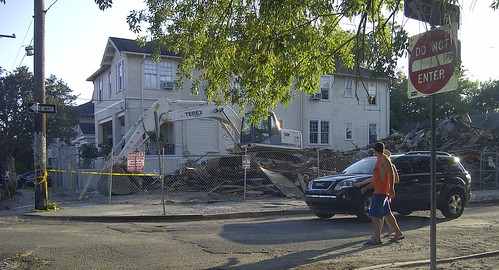
The Pike rape den dies an ironic death: turned into a police station.
Backstory.
Friday, May 6, 2011
A picture is worth a thousand words
A few interesting graphics I've come across recently (click to enlarge):

That's not the tail rotor of a Blackhawk helicopter. Backstory here, from Wired.
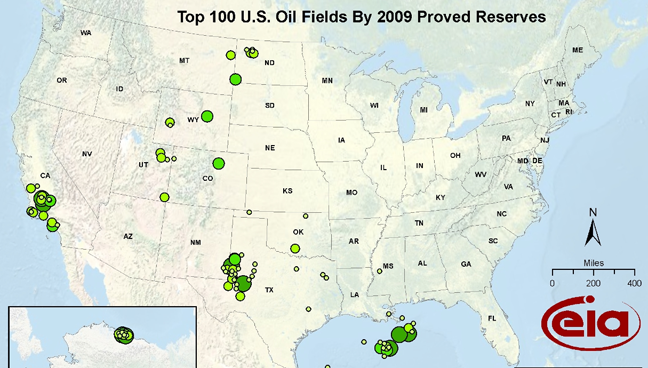
Top Oilfields in the US, by proven reserves. From The Oil Drum.

Growth Spurt. From NSPE Magazine.
Also: Louisiana #45 on Science and Technology Development Index: (PDF Charts).
BONUS: Macondo, 1 Year Later. The Big Picture, Boston Globe. Don't forget to click the images to see the before/after.
UPDATE- 1 more:
From DNV Macondo Report:


That's not the tail rotor of a Blackhawk helicopter. Backstory here, from Wired.
Top Oilfields in the US, by proven reserves. From The Oil Drum.
Growth Spurt. From NSPE Magazine.
Also: Louisiana #45 on Science and Technology Development Index: (PDF Charts).
BONUS: Macondo, 1 Year Later. The Big Picture, Boston Globe. Don't forget to click the images to see the before/after.
UPDATE- 1 more:
From DNV Macondo Report:

Sunday, May 1, 2011

Sunday, April 17, 2011
Project Truck Update: a Patch for Patches
The weather was great this weekend and no festivals, so I went over and got a little done on Patches.
There have been a few holes in the floor of the cab from the get go.
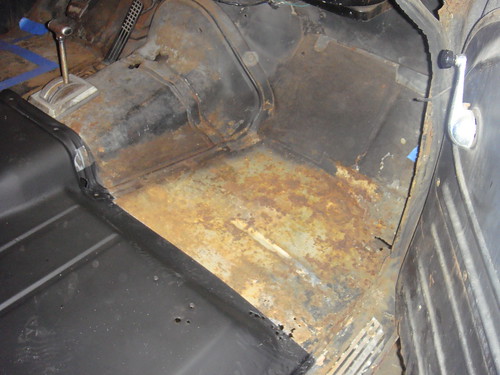
I'd like to have these taken care of before I'm leaning on them replacing the wiring harness. After removing the gas tank, I first tried grinding the holes out and then welding in metal.
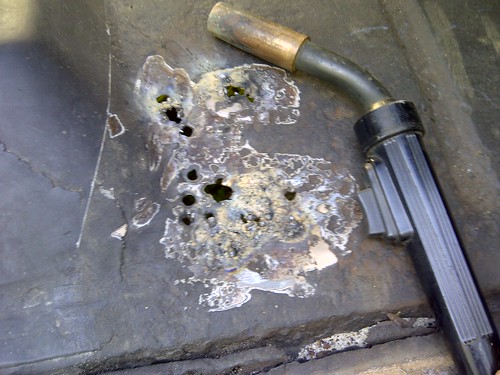
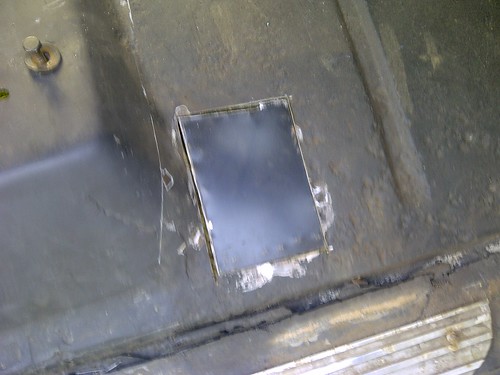
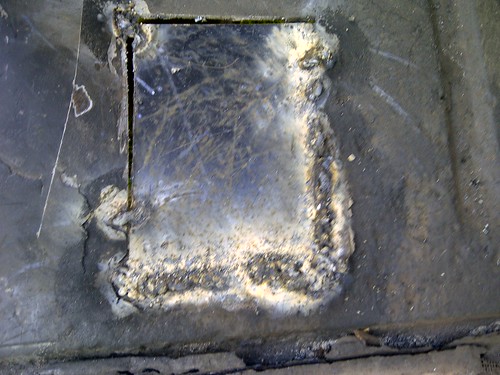
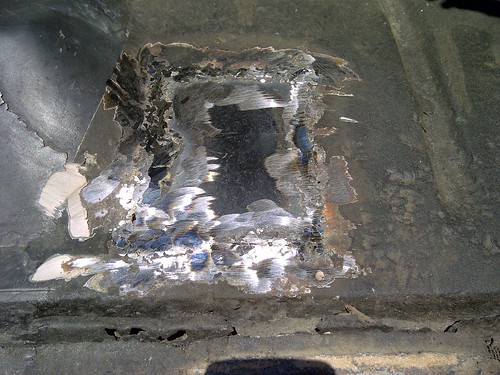
That didn't work out too well. I just burned straight through the sheet metal. I then cut out a square patch of rotten metal, cut a replacement from the thickest sheet metal I had on hand (which was STILL thinner than what they used building Patches) and welded it up strong enough for Paul Prudhomme to jump on.
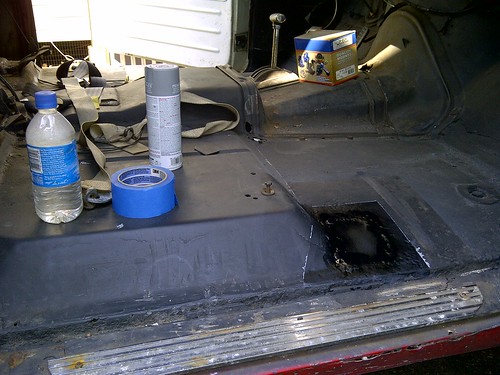
There have been a few holes in the floor of the cab from the get go.
I'd like to have these taken care of before I'm leaning on them replacing the wiring harness. After removing the gas tank, I first tried grinding the holes out and then welding in metal.
That didn't work out too well. I just burned straight through the sheet metal. I then cut out a square patch of rotten metal, cut a replacement from the thickest sheet metal I had on hand (which was STILL thinner than what they used building Patches) and welded it up strong enough for Paul Prudhomme to jump on.
Friday, April 15, 2011
From the mailbag...

Only in New Orleans does the guy who comes up with you tax bill ask you to a $500/plate dinner.
More background here.
Notes on the 2011 Tulane Engineering Forum
I got a chance to attend the 2011 Tulane Engineering Forum and the forum continues to grow. This year drew over 600 engineers. The day before I went, one of my coworkers teased me that going to an engineering conference hosted by Tulane was like going to an easter egg hunt hosted by the Ayatollah in Tehran*.
One of the things I've really come to like about the TEF's are that I'll pick up on some really nice phrases/wordplays/sayings. Some of my favorites from this year:
* "Worry Budget"
* "Assumed-Away" (dealing with risk)
* "Science as a contact sport" (engineering as well, sometimes)
* "Compartmentalized engineers" (missing out on the big picture)
* "Dynamic Regulation" (constantly in-flux regulatory rules that are poison for projects that take 10 years to develop) {Another quote from the same guy, "[MMS] served our industry well for a number of years"}
* "Everyone supports it, until you put your finger on a map" (coastal restoration)
* "Engineering meets public health meets Indiana Jones" (Engineers Without Borders)
* And my favorite of the year: "Unavoidable uncertainty in complex systems" (talking about scientists dealing with the public on complex topics)
This year's theme was the Macondo blowout. I attended the Morning Plenary Session (which included a dispersant expert from XOM, a ChemE professor from LSU, an MBA from Tulane, and the head of research for ULL), but ended up attending mostly coastal restoration and infrastructure lectures. My personal favorite lecture of the day was given by Dr. Allisha Renfro who pinch-hit for a presenter who was out. She did a science and engineering postmortem on 3 coastal projects: MR-GO**, the West Bay Diversion, and the Myrtle Grove Pulsed Sediment Diversion (which was held up as a model for future projects).
__________
* Maybe he read this article?
** Even if you ignore all the "secondary" effects (levee failures, wetlands loss, etc.), MR-GO was a MASSIVE failure on its primary objective: serve commerce. Taxpayers ended up subsidizing MR-GO (from its opening in 1968 to its closure recently) by $20,000/vessel, clearly a massive failure in its primary objective (lower transportation costs). There was also plenty of science, engineering, and economic expertise that warned against the project before it was ever begun, but the powers that be pressed on anyways.
Last year's forum notes.
One of the things I've really come to like about the TEF's are that I'll pick up on some really nice phrases/wordplays/sayings. Some of my favorites from this year:
* "Worry Budget"
* "Assumed-Away" (dealing with risk)
* "Science as a contact sport" (engineering as well, sometimes)
* "Compartmentalized engineers" (missing out on the big picture)
* "Dynamic Regulation" (constantly in-flux regulatory rules that are poison for projects that take 10 years to develop) {Another quote from the same guy, "[MMS] served our industry well for a number of years"}
* "Everyone supports it, until you put your finger on a map" (coastal restoration)
* "Engineering meets public health meets Indiana Jones" (Engineers Without Borders)
* And my favorite of the year: "Unavoidable uncertainty in complex systems" (talking about scientists dealing with the public on complex topics)
This year's theme was the Macondo blowout. I attended the Morning Plenary Session (which included a dispersant expert from XOM, a ChemE professor from LSU, an MBA from Tulane, and the head of research for ULL), but ended up attending mostly coastal restoration and infrastructure lectures. My personal favorite lecture of the day was given by Dr. Allisha Renfro who pinch-hit for a presenter who was out. She did a science and engineering postmortem on 3 coastal projects: MR-GO**, the West Bay Diversion, and the Myrtle Grove Pulsed Sediment Diversion (which was held up as a model for future projects).
__________
* Maybe he read this article?
** Even if you ignore all the "secondary" effects (levee failures, wetlands loss, etc.), MR-GO was a MASSIVE failure on its primary objective: serve commerce. Taxpayers ended up subsidizing MR-GO (from its opening in 1968 to its closure recently) by $20,000/vessel, clearly a massive failure in its primary objective (lower transportation costs). There was also plenty of science, engineering, and economic expertise that warned against the project before it was ever begun, but the powers that be pressed on anyways.
Last year's forum notes.
Monday, April 4, 2011
Lawyers try to make a fool out of an engineer, get Pi on face
Today brought the return of the USCG/BOEMRE Hearings on the loss of the Deepwater Horizon. For an example of what they're going for, check out the Ocean Ranger Report or the Cullen Report [PDF] from the Piper Alpha disaster. Unfortunately, this BOEMRE/USCG investigation, instead of being a technical probing of a failure has become a legal sparing match. I want to focus on one little incident from today's testimony.
Throughout the whole inquiry, the lawyers for the various parties have totally flubbed even minor technical details. There's one BP lawyer in particular who looks like he's never had a single math course beyond Prob Stat 101 that was required for his undergrad degree. Today, there was an exchange between the lead project manager and lead investigator for the DNV BOP report and several of the lawyers. The Times-Pic reported about various "uncertainties" about the massive DNV Report (Volume 1, PDF). I've gone through both volumes and the report stands up pretty strong. There might be a little detail here and there that could be better, but nothing compared to the concerns these lawyers are broaching.
The lawyers then began attacking the credibility of the lead project manager. They asked him if, before the Deepwater Horizon incident, if the lead project manager had ever seen a BOP firsthand. The lead project manager replied no, and the lawyers seized on this as evidence of "government incompetence." What shocked me most of all is the "Times-Picayune Staff" decided to feature this drivel as their "comment of the day" including the claim that Det Norske Veritas, which certifies various marine equipment (including BOP's), knows nothing about BOP's:
To hire an engineering firm that has never "seen or heard of" a BOP to conduct a forenic [sic] investigation on this equipment is rediculous. [sic]
Commenter "edjn50," from Folsom, LA, is obviously a product of Louisiana's woefully underfunded education system.
Do a little Googling and you'll learn that Neil Thompson, the project manager, has extensive experience in several fields and a PhD in Materials Science and Engineering from Vanderbilt. The lead PM and investigator are just the head of a large team, which includes experts in Finite Element Analysis and BOP's.
We'll see how well the DNV report holds up, but these lawyers are obviously trying to do whatever they can to limit their company's legal exposure. The worst incident of the day came from that same idiot BP lawyer who questioned Dr. Thompson on what elastic deformation was. The idiot BP lawyer claimed that "nobody in the oil industry has ever heard of elastic deformation." Fucking dunce! I'm in the oil biz and I learned about it in my sophomore-level Materials Science course. It's on page 117 of my textbook. I can only sympathize with that poor engineer trying to teach bloody English majors mechanical engineering while under oath. Flummoxing your opponent with your total ignorance might be an effective legal strategy, but is no way to run an investigation of an engineering disaster.

Idealized Plastic and Elastic Deformation regions in metals, from Wikipedia
UPDATE- Also, one more thing worthy of interest: Chron article about new BP emails. Note Sims was the only BP engineer who actually had a P.E.
UPDATE 2- Godfrey [Annoying BP lawyer] suggested that nobody in the industry had ever seen such "elastic buckling" of a drill pipe before. But Thompson said it's a commonly understood concept of physics. Note that drill string is called a string precisely because of the elastic nature of the elongated sections when joined together. They hang like a string from the derrick. The elasticity is what allows for directional drilling, for example.
UPDATE 3- Rigzone weighs in on the "unqualified opinion." More english-major foot-in-mouth.
Also: more Gulf of Mexico concerns. Petrobras, which had an interesting kablewey 10 years ago, has some problems on the first FPSO in the Gulf. Note that I've been concerned in the past at how it would handle a hurricane.
UPDATE 4- Transcripts posted. One of the investigators worked on the King's Cross investigation. Very impressive. BP's rebuttal witness, despite some 40 years of BOP operational experience, flubbed some basic materials science questions. Not very impressive.
Throughout the whole inquiry, the lawyers for the various parties have totally flubbed even minor technical details. There's one BP lawyer in particular who looks like he's never had a single math course beyond Prob Stat 101 that was required for his undergrad degree. Today, there was an exchange between the lead project manager and lead investigator for the DNV BOP report and several of the lawyers. The Times-Pic reported about various "uncertainties" about the massive DNV Report (Volume 1, PDF). I've gone through both volumes and the report stands up pretty strong. There might be a little detail here and there that could be better, but nothing compared to the concerns these lawyers are broaching.
The lawyers then began attacking the credibility of the lead project manager. They asked him if, before the Deepwater Horizon incident, if the lead project manager had ever seen a BOP firsthand. The lead project manager replied no, and the lawyers seized on this as evidence of "government incompetence." What shocked me most of all is the "Times-Picayune Staff" decided to feature this drivel as their "comment of the day" including the claim that Det Norske Veritas, which certifies various marine equipment (including BOP's), knows nothing about BOP's:
To hire an engineering firm that has never "seen or heard of" a BOP to conduct a forenic [sic] investigation on this equipment is rediculous. [sic]
Commenter "edjn50," from Folsom, LA, is obviously a product of Louisiana's woefully underfunded education system.
Do a little Googling and you'll learn that Neil Thompson, the project manager, has extensive experience in several fields and a PhD in Materials Science and Engineering from Vanderbilt. The lead PM and investigator are just the head of a large team, which includes experts in Finite Element Analysis and BOP's.
We'll see how well the DNV report holds up, but these lawyers are obviously trying to do whatever they can to limit their company's legal exposure. The worst incident of the day came from that same idiot BP lawyer who questioned Dr. Thompson on what elastic deformation was. The idiot BP lawyer claimed that "nobody in the oil industry has ever heard of elastic deformation." Fucking dunce! I'm in the oil biz and I learned about it in my sophomore-level Materials Science course. It's on page 117 of my textbook. I can only sympathize with that poor engineer trying to teach bloody English majors mechanical engineering while under oath. Flummoxing your opponent with your total ignorance might be an effective legal strategy, but is no way to run an investigation of an engineering disaster.

Idealized Plastic and Elastic Deformation regions in metals, from Wikipedia
UPDATE- Also, one more thing worthy of interest: Chron article about new BP emails. Note Sims was the only BP engineer who actually had a P.E.
UPDATE 2- Godfrey [Annoying BP lawyer] suggested that nobody in the industry had ever seen such "elastic buckling" of a drill pipe before. But Thompson said it's a commonly understood concept of physics. Note that drill string is called a string precisely because of the elastic nature of the elongated sections when joined together. They hang like a string from the derrick. The elasticity is what allows for directional drilling, for example.
UPDATE 3- Rigzone weighs in on the "unqualified opinion." More english-major foot-in-mouth.
Also: more Gulf of Mexico concerns. Petrobras, which had an interesting kablewey 10 years ago, has some problems on the first FPSO in the Gulf. Note that I've been concerned in the past at how it would handle a hurricane.
UPDATE 4- Transcripts posted. One of the investigators worked on the King's Cross investigation. Very impressive. BP's rebuttal witness, despite some 40 years of BOP operational experience, flubbed some basic materials science questions. Not very impressive.
Saturday, April 2, 2011
Tulane plowing millions into football?
Cowen Pledges Greater Football Funding - The Hullabaloo. Excellent Article.
This is a curious little announcement. I've asked around and what the administration is thinking is they've done research. Their surveys indicate that there's a strong correlation between football programs and alumni donations. Good foobtall programs have a high rate of alumni donorship, while bad football programs generally correlate with poor alumni donorship. That's what I've heard from a couple of different sources on the administration's thinking. The overall plan is to pump up the football program (which loses a couple million dollars a year) so that it at least stands on its own feet and the halo effect of a better football team would pump up alumni donations. At least, that's the plan.
I'll add a few bits of history. Tulane was a founding member of the SEC. They left because "the board thought they could make more money as an independent, like Notre Dame."
Tulane also had Sugar Bowl Stadium (seating 80,000+), which they tore down and shifted over to the Superdome. That one is actually fairly understandable at the time. They didn't have the money to do the extensive renovations the stadium needed and there was this big, shiny new stadium downtown. Unfortunately, the Superdome is the absolute worst venue possible for a small football program. 20,000 fans (a good Tulane attendance figure) are lost in the cavernous, freezing cold stadium. Note that Cowen mentions a fund-raising drive of $60 million to build an Uptown stadium. From what I'm told, it would be ~30,000 seats and be situated one of three locations: wedged into the practice field area (behind Riley Center; tight, but possible), Audubon Park, or Uptown Square, which Tulane acquired about 6 or 7 years ago. We'll see how the neighbors react if they get the money lined up and want to start construction.
I know that Cowen isn't exactly on my Christmas card list, but take a look at the track record. When Cowen arrived at campus we had a Bowden-led football team with offensive genius of Rich Rodriguez calling a potent offense, the oldest degree granting college for women (Newcomb), engineering programs so old, they dated to founding of ABET (in addition to other, smaller academic programs eliminated in the Renewal Plan), and the Princeton Review ranked Tulane #31 overall. Now, we're ranked #51 (Tulane has griped and moaned about using Katrina-tainted data for dropping it out of the top 50 {well, what about the other 19 spots...}) and we're the only top 50 {51} school without an ABET-accredited program in Computer Science (go ahead and look it up for yourself). Even LSU has (finally) gotten their CS program accredited!
I really want Tulane to do well, but we'll have to see where things are headed. I just can't help wondering if this is really the best way to spend this money.
******************************
Here's Cowen's email:
UPDATE- Changed capacity figure for Sugar Bowl Stadium.
This is a curious little announcement. I've asked around and what the administration is thinking is they've done research. Their surveys indicate that there's a strong correlation between football programs and alumni donations. Good foobtall programs have a high rate of alumni donorship, while bad football programs generally correlate with poor alumni donorship. That's what I've heard from a couple of different sources on the administration's thinking. The overall plan is to pump up the football program (which loses a couple million dollars a year) so that it at least stands on its own feet and the halo effect of a better football team would pump up alumni donations. At least, that's the plan.
I'll add a few bits of history. Tulane was a founding member of the SEC. They left because "the board thought they could make more money as an independent, like Notre Dame."
Tulane also had Sugar Bowl Stadium (seating 80,000+), which they tore down and shifted over to the Superdome. That one is actually fairly understandable at the time. They didn't have the money to do the extensive renovations the stadium needed and there was this big, shiny new stadium downtown. Unfortunately, the Superdome is the absolute worst venue possible for a small football program. 20,000 fans (a good Tulane attendance figure) are lost in the cavernous, freezing cold stadium. Note that Cowen mentions a fund-raising drive of $60 million to build an Uptown stadium. From what I'm told, it would be ~30,000 seats and be situated one of three locations: wedged into the practice field area (behind Riley Center; tight, but possible), Audubon Park, or Uptown Square, which Tulane acquired about 6 or 7 years ago. We'll see how the neighbors react if they get the money lined up and want to start construction.
I know that Cowen isn't exactly on my Christmas card list, but take a look at the track record. When Cowen arrived at campus we had a Bowden-led football team with offensive genius of Rich Rodriguez calling a potent offense, the oldest degree granting college for women (Newcomb), engineering programs so old, they dated to founding of ABET (in addition to other, smaller academic programs eliminated in the Renewal Plan), and the Princeton Review ranked Tulane #31 overall. Now, we're ranked #51 (Tulane has griped and moaned about using Katrina-tainted data for dropping it out of the top 50 {well, what about the other 19 spots...}) and we're the only top 50 {51} school without an ABET-accredited program in Computer Science (go ahead and look it up for yourself). Even LSU has (finally) gotten their CS program accredited!
I really want Tulane to do well, but we'll have to see where things are headed. I just can't help wondering if this is really the best way to spend this money.
******************************
Here's Cowen's email:
Good Morning:
It has been about six years since Katrina almost destroyed New Orleans and Tulane University. Since that time, Tulane has not only survived but has reimagined itself and become stronger academically and financially. This recovery has not been easy, but the Tulane community was determined to move forward. We have made substantial progress in achieving our academic and financial goals, which have been the primary focus of our efforts since August 29, 2005.
We are now in the stage of our renewal where we can and should continue to focus on the development and success of Tulane Athletics. Next year we will once again field 16 sports teams, fulfilling the NCAA's requirement for competing at the highest level of collegiate athletics.
We have made major commitments to our baseball, basketball and volleyball programs, with a new practice and training facility currently under construction for the latter programs and beautiful Greer Field at Turchin Stadium for our baseball team. These improvements were consistent with the university's recovering finances after Katrina and were made with our academic priorities always in mind. We are proud of what has been accomplished in athletics given all the unprecedented challenges we faced. But the task is not yet complete. Our next goal, which will be the most difficult one to accomplish, is to build a consistently successful football program.
Our vision for football is a program that opens every campaign with the talent and resources to win our division and conference and participate in post-season games - as opposed to one that has periodic winning seasons, which has been the experience at Tulane for the last five or six decades. We will not achieve this overnight, but we must begin the journey for success right now with clear and unambiguous progress made every year, starting with this coming season.
An overview of the evolving plan to accomplish this goal is outlined in The Playbook. In the months ahead we will refine our plans as we marshal the resources necessary to achieve our goals. We will build a successful football program while adhering to Tulane's philosophy of enrolling student-athletes who desire a first-rate education. Our student-athletes are committing their collegiate careers to achieve at high levels, on and off the field, and our coaches will dedicate every bit of their talent and experience to help them in their quest.
For us to be successful, it will require a true team effort -- an effort comparable to what we did after Katrina when many naysayers around the country counted us out. The journey now begins; we hope you will join us.
Have a great weekend,
Scott
UPDATE- Changed capacity figure for Sugar Bowl Stadium.
Sunday, March 20, 2011
Saturday, March 5, 2011
Thinking ahead
Getting back to doing a bit of posting, so I figure I'd post what's been on my mind the most.
After taking the P.E., I was wondering what to do with all of my free time. I've worked a little more on Patches (weather permitting). I've also been doing some thinking.
I've talked with a friend of mine and he said that for an engineer my age, more and more, the Master's degree is the "expected" degree. In a few years, Civil engineers will be required to have a Master's before they're allowed to sit for the P.E. This additional requirement is being pushed mainly by structural engineers. Also, from studying for the P.E., you realize how much is still out there that you really don't know and it's always nice to supplement your technical knowledge. There's also the thought of taking a few business classes.
I've signed up to go back to grad school. I've previously talked about it, but now I've signed up. I've taken the GRE (750 Quantitative; the English score doesn't matter for an engineer*) and filled out a bunch of forms to go to UNO.
One thing I will do when I go back is, as much as schedule allows, take what I'm interested in. As an undergrad, approximately 120 out of 140 hours are basically dictated to you and (especially if you're going through it in 4 years like me) it's a rush to get through.
Oh well. Back to drinking beer and bloody mary's for now.
UPDATE- Another interesting story from a coworker. He used to work for a big public utility in California. There, the engineers were encouraged to get lots of credentials. The recommended track was PE, MBA, Master's, then finally PhD. The goal was to have whatever engineer is working on a project be able to sit in front of the public service commission and beat them over the head with credentials until they got the rate increase they were looking for.
__________________
* The application should read: "Do you speak English? ... No? Well, we'll let you teach anyway if you want to anyway."
After taking the P.E., I was wondering what to do with all of my free time. I've worked a little more on Patches (weather permitting). I've also been doing some thinking.
I've talked with a friend of mine and he said that for an engineer my age, more and more, the Master's degree is the "expected" degree. In a few years, Civil engineers will be required to have a Master's before they're allowed to sit for the P.E. This additional requirement is being pushed mainly by structural engineers. Also, from studying for the P.E., you realize how much is still out there that you really don't know and it's always nice to supplement your technical knowledge. There's also the thought of taking a few business classes.
I've signed up to go back to grad school. I've previously talked about it, but now I've signed up. I've taken the GRE (750 Quantitative; the English score doesn't matter for an engineer*) and filled out a bunch of forms to go to UNO.
One thing I will do when I go back is, as much as schedule allows, take what I'm interested in. As an undergrad, approximately 120 out of 140 hours are basically dictated to you and (especially if you're going through it in 4 years like me) it's a rush to get through.
Oh well. Back to drinking beer and bloody mary's for now.
UPDATE- Another interesting story from a coworker. He used to work for a big public utility in California. There, the engineers were encouraged to get lots of credentials. The recommended track was PE, MBA, Master's, then finally PhD. The goal was to have whatever engineer is working on a project be able to sit in front of the public service commission and beat them over the head with credentials until they got the rate increase they were looking for.
__________________
* The application should read: "Do you speak English? ... No? Well, we'll let you teach anyway if you want to anyway."
Mardi Gras 2011 - Muses vs. Krewe D'Etat
We're resting a bit before the madness of tomorrow's 5 parades. We'll have to fend off the barbarian hordes (Endymion watchers) and their ladders and encampments.
One funny note: the Muses vs. Krewe D'Etat battle going on.

Krewe D'Etat Float 6, "Triple Sow Cow"
This is the float that Krewe D'Etat ran. Here's what their pamphlet said:

TRIPLE SOW COW – What’s this mooooving down the parade route? An over-stuffed, bovine figure skater? While we doubt the Swedish ice-skating master had this in mind when he created the triple sow cow, our version of this now classic move features a certain “krewe“ of whirling dervishes whose spins on things have slung mud (and ice) on many others in the past. But this time, the high-heeled mudslingers are in for the Tonya Harding treatment themselves. Mooooving targets are hard to hit, but the Dictator’s aim is true here, scoring a perfect 6.0. In addition to tossing out the high and low scores, watch for the old footwear that might also be flung from this float. Who knows, perhaps this year these full-figured skaters might even be able to witness this spectacle, rather than once again riding in our wake.
It mercilessly makes fun of the Krewe of Muses. The Muses ladies are pissed. I can't wait for the response.

UPDATE- One other little thing to think about is the background of the Krewes. Muses is a bunch of artsy women. Krewe D'Etat is basically the sons of the Momus and Comus crowd that are pissed the old line krewes don't parade anymore. That'll be funny to see as things develop.
One funny note: the Muses vs. Krewe D'Etat battle going on.
Krewe D'Etat Float 6, "Triple Sow Cow"
This is the float that Krewe D'Etat ran. Here's what their pamphlet said:
TRIPLE SOW COW – What’s this mooooving down the parade route? An over-stuffed, bovine figure skater? While we doubt the Swedish ice-skating master had this in mind when he created the triple sow cow, our version of this now classic move features a certain “krewe“ of whirling dervishes whose spins on things have slung mud (and ice) on many others in the past. But this time, the high-heeled mudslingers are in for the Tonya Harding treatment themselves. Mooooving targets are hard to hit, but the Dictator’s aim is true here, scoring a perfect 6.0. In addition to tossing out the high and low scores, watch for the old footwear that might also be flung from this float. Who knows, perhaps this year these full-figured skaters might even be able to witness this spectacle, rather than once again riding in our wake.
It mercilessly makes fun of the Krewe of Muses. The Muses ladies are pissed. I can't wait for the response.
UPDATE- One other little thing to think about is the background of the Krewes. Muses is a bunch of artsy women. Krewe D'Etat is basically the sons of the Momus and Comus crowd that are pissed the old line krewes don't parade anymore. That'll be funny to see as things develop.
Subscribe to:
Comments (Atom)