Showing posts with label Louisiana. Show all posts

Thursday, December 28, 2017

What to do next

My previous post focused on the largest Louisiana industrial employers for 3 reasons:
1- they impacted the most people
2- there's the most public domain information on them, so they are the easiest to talk about
3- they are reflective of general trends
There are other small and medium firms that have gone through similar struggles (or might even be thriving), but the big ones are the easiest to talk about.  

I also ended on somewhat of a down note.  I'd like to throw out a few ideas on some various projects that might help right the ship.  Some of them are Megaprojects, which carry special risks as megaprojects are by definition extremely complex, difficult to execute, but, if successfully executed, can be home runs.  A poorly executed project could have the result of looking like Mississippi's Gulfport Port expansion debacle or the Kemper Gassification Plant boondoggle.   Always be on your toes...

Just throwing a few ideas out there, with simple pro/con's for brainstorming, in no particular order:
* LIGTT (nicknamed "Leg-It") or similar truly deepwater port.  
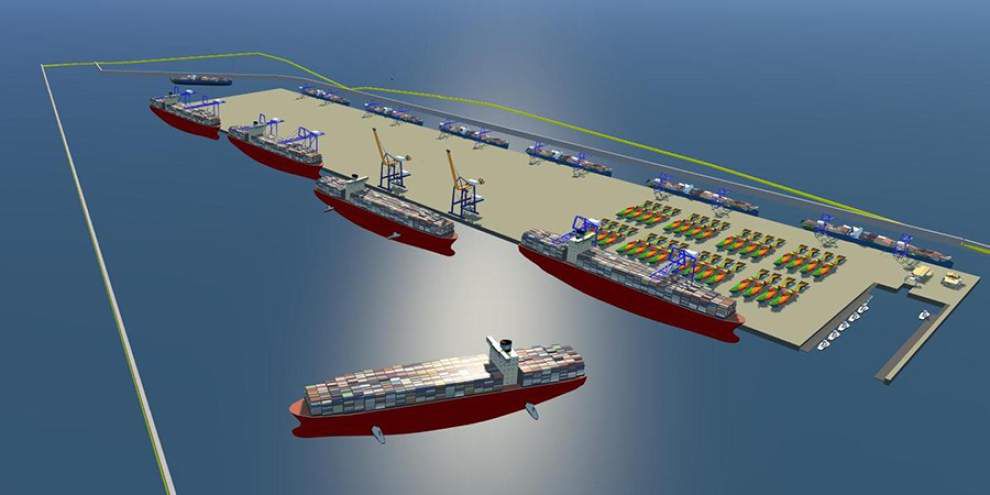
Image result for Louisiana  LGITT deepwater port
(Photo: Advocate).
Pro: Deepwater port would built upon increased traffic from the Neopanama Canal.  Draft does limit access to the Port of New Orleans, especially during the fall when river levels fall and harvests (exports) are at their strongest.  
Con: Expensive ($2B?), lots of dredging.  The biggest risk is vulnerability to a big storm.  A monster storm would wipe the slate clean, like what happened to Gulfport after Katrina.  On the flip side, quite a few Gulf Coast ports are extremely vulnerable to a direct hit from a monster storm, so LGITT wouldn't be that much riskier than the competition.  Heck, the Port of Houston got walloped and it's well inland and was hit by merely a Category 4.  

* Gas-To-Liquids (GTL).  
Pro: utilize cheap natural gas to make higher value added products, usually diesel and lubricants.  
Con: CAPEX intensive.  It requires a large spread in price between gas feedstock and (high) liquids price.  Gas prices are currently cheap, but liquids pricing not enough right now to really justify the initial capital investment.  Both Shell and Sasol have recently pulled the plug (after strongly considering it).  It might happen someday, but not likely anytime soon.  Something like more efficient catalysts might cause a breakthrough, though.  Don't count it completely out.  

* Liquefied Natural Gas (LNG)
Con: I have mixed feelings about this one.  I worry about too much a rush towards this at once where too many players enter at once and the whole market tanks.  I'm not the only one thinking that.  I also wonder if it's not better to add as much value to raw materials as possible before export rather than just exporting our natural resources on the commodity market.

* Space-X and/or NASA heavy lift vehicle built at Michoud
Pro: Hell yeah!  Huge manufacturing facility with access to the Intracoastal Waterway allows really big things to be chucked into space.
Con: $$$$$$$$$$$$$$ :-(.  I can at least re-read The Martian sometime and dream.

* Deepen the Intracoastal waterway
Pro: this would benefit many coastal areas, but especially Louisiana.  
Con: this would have to be done at the federal level.  The costs would increase exponentially the deeper you went.  Right now, it's ~12'.  If you went deeper, say, 25', that gets really expensive fast (at least in certain segments).  

* A second Baton Rouge bridge across the Mississippi.
Pro: Anyone who's driven through Baton Rouge between Noon and 6 PM on a weekday in the past 20 years will tell you it's sorely needed.
Con: Probably >$1B.  The state is broke and would be the most obvious candidate to fund much of the bridge.  PPP looks to be the popular choice at the moment and that means tolls, probably high ones, for quite a while.  Louisiana only has a handful of bridges with tolls (despite having lots of waterways) and don't like paying tolls.  

* Electrified freight (passenger?) rail
Pro: This was one that really fascinated me on The Oil Drum (back when that was still kicking).  It can be a silver BB that hits lots of birds with one stone.  
Con: would be most effective if done on an interstate basis.  

* River Diversion South of New Orleans
Image result for Is It Feasible to Build New Land in the Mississippi River Delta?
Pro: We could start cleaning up the environmental mess we left in this state.  Can help buffer against future storm surges.  2 paired diversions (one on the eastbank, one on the westbank somewhere downriver from English Turn).  
Con: I might be dead before this thing ever gets off the ground.  It's been discussed for ages, but money and permitting are perennial headaches.  

Just something to noodle a while.  


Wednesday, December 27, 2017

The Deindustrialization of South Louisiana


The oil bust has started to level out, but we're still seeing the effects of the deindustrialization of South Louisiana, it's been touched on by The Advocate and Library Chronicles  and I'd like to take a moment to discuss it a bit further.  It's had some coverage in the media, but nobody has ever really managed to tie together a lot of threads to my liking.  

Louisiana went from ~172k manufacturing jobs to just ~135k.  Employment isn't even flat, not to mention lagging population growth.  

(From The Advocate)

Some of this is natural boom/bust cycle of mineral extraction, but lately there's been more than that.  
The above graph is mining/logging (upstream oil and gas) employment in Louisiana from the Bureau of Labor Statistics.  You can see the big dropoff that led to the latest oil bust (the worst bust in at least a generation).  There's been somewhat of a boom in the downstream (refining) and midstream (pipeline) side of the oil patch, but that's been somewhat muted and hasn't completely softened the blow.  The recent runup to ~$65/bbl also hasn't done a lot to revive job growth.  

Louisiana used to also have a more diverse group of manufacturers.  For example, Michoud used to crank out external tanks for the Space Shuttle program.  

As the shuttle program slowed to a crawl after the Columbia explosion and eventually ended, Michoud went into a semi-dormant state.  It's not shuttered; they still make several things at Michoud (structural components for the F-35, some big LNG tanks, and components of the delayed Space Launch System [SLS] program).  Michoud is a special facility; if you want to send something big into space and launch it from the Cape, you pretty much have to build it at Michoud so a renaissance someday under, say, SpaceX isn't out of the question.

Louisiana's largest industrial employer up until very recently was Avondale Shipyard.  I recently read a book, The Yard, by Michael Sanders, that was primarily about Bath Iron Works, but talked quite a bit about how healthy Avondale  at that time (2001)  in comparison to the other Navy shipyards.  I half expected the book to end with the closure of Bath and success of Avondale.  Avondale had the cheapest labor pool of any of the major naval shipyards, had large facilities, and out of all the naval shipyards had the best track record of doing commercial/nongovernmental work.  One would think that those advantages would keep the yard open.

Unfortunately, as we all know Avondale Shipyard closed.  There's still a very small amount of engineering and drafting work being done at Avondale, but it's pretty much closed.  Recently, the floating drydock was towed away (for scrapping?) in South America:
Photo via WGNO.

Without that floating drydock, Avondale will never be a real shipyard again.  That drydock has a side that drops away and allows for large vessels to be onloaded, floated out, and gently launched in the water.  Launching a big ship the old fashioned way (via a Ways) is too risky and too complicated to do for large vessels in as tight and congested a waterway as the Mississippi.  Building a new drydock would cost at least $50m on top of acquisition costs for the shipyard.  I heard a rumor Huntington Ingalls is asking $40m for the site; the Port of New Orleans, one of the few potential buyers heard that price and laughed.

Why did Avondale close?  There's always a plethora of reasons for something big like this (many detailed here), but a few I'll touch on are first off, the general downturn in naval shipbuilding (after the buildup of the 80's combined with the demise of the Soviet Union, just not as much of a need), the demise of the domestic shipbuilding industry after the elimination of Tittle XI of Commercial Differential Subsidies in 1981 (more here and here in Chapter 10 of "Staying Afloat"), the failure to adopt more modern construction techniques (Avondale was actually the first US shipyard to install an automated panel-line welder, but later lagged in the adoption of "Group Technology" shipbuilding practices), and the consolidation of the industry.  That last one is the final nail in the coffin, as Avondale and Pascagoula were both owned by Newport News Shipbuilding [Northrup Grumman] and as there was less work to go around, the corporate parent picked which child it wanted to live and which to let whither away.

Pascagoula also had an added advantage in that last fight: Pascagoula was awarded nearly $2B to rebuild after Hurricane Katrina; Avondale didn't get such an award [but did have significant disruption to its workforce housing in Katrina].  Taxpayers basically bought Huntington Ingalls a brand new shipyard.  If you could only keep one shipyard open, which would you choose: the brand new, modern, efficient one or the old one that has airdraft restrictions (bridge height)?  There was a GAO audit against Pascagoula and they didn't get to keep all of the $2B, but they kept enough to make the difference.

The other major industrial employer in South Louisiana that used to employ nearly as many as Avondale (at least when times were good) was McDermott's large fabrication facility in Amelia, Louisiana.  The Amelia facility started in 1956 and went on to build some of the largest and most complicated offshore structures of anyplace on earth.  It actually outgrew its first location on Bayou Beouf and moved further down the bayou.  When times boomed, it'd be end to end jackets spread over hundreds of acres with thousands of workers.
1977 Press Photo Project Cognac, Drilling Platform for Shell Oil Company
Being attached to a highly cyclic industry, the workforce size rose and plunged with the price per barrel, but McDermott seemed to hold onto enough talent during the busts to be the quickest on their feet when the boom returned.  One example of how I've heard is the McDermott side of the story of the American Queen.  Everyone hated working on the American Queen.  The vessel was actually built mostly on spec by McDermott without a really firm contract up front.  The fab yard never really wanted to become a shipyard (oil patch and shipbuilding being dissimilar enough), but the management knew a boom would later come and wanted to hold onto as many hands as possible.  Suppliers got pushed around and annoyed, workers were ridden hard, but eventually the ship was finished in 1995, just in time to clear the yard for Shell's series of TLP's mostly built at McDermott (whose hulls were built overseas and generally integrated to the Topsides elsewhere).  While it was a rough project that McDermott didn't make a profit on, the boat filled timesheets and a lot of folks learned good lessons from that project.  The American Queen didn't do well under the first operator, who went into bankruptcy, but the new owner is doing quite well, so I've heard.  It seems that American tourists are too terrified of getting beheaded by ISIS to go on Danube cruises and are sticking closer to home.

So, it came as some surprise when lots of rumors of the Amelia Fab yard's closure started to come out in the early 2010's.  Oil prices were still well over $100/Bbl.  But, McDermott, who used to be the top name in offshore fabrication had been slowly supplanted by Kiewitt Offshore Services (KOS) in Ingleside, TX.

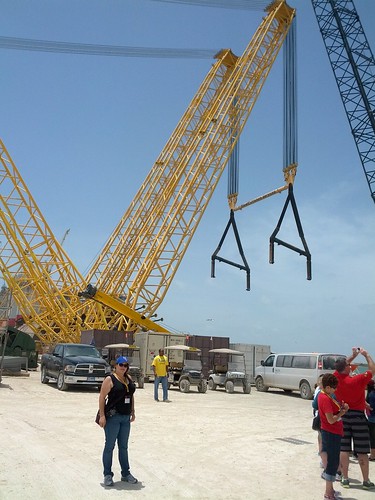
One of Kiewitt's keys was the HLD (Heavy Lifting Device):
Candice and HLD

Engineers should never be allowed to name anything because HLD is a horrible name; the largest crane in the Western Hemisphere should have a cooler name than that.  The HLD allowed the lifting of bigger, more complete modules for deeper water, more complicated platforms.  One story I've heard is that the HLD was actually a "design in a drawer" that originated with McDermott engineers, but management didn't have the vision to see the market and balked at the pricetag. Those engineers quit, convinced Kiewitt to enter the market with a substantially lower, innovative bid that beat McDermott to win one project and Bullwinkle Constructors LLC (a limited liability corporation Kiewitt partnered in) was later converted into KOS.

McDermott

McDermott Amelia's days were numbered as the rumors turned out to be true.  McDermott shifted its operations to Altamira Mexico, where they've hired a thousand workers this year, even in a down market.  Their New Orleans engineering office was also shuttered as everything consolidated to Houston.

The upswing of a sustained oil boom are over.  The state now has a hangover with massive job loses (in fact, Houma-Thibodaux currently has the fourth most depressed economy in the nation (ranked by census tract), TOPS perennially teetering on insolvency and the state's budget is in shambles.  What comes next?  Does everyone just pack up for Houston?  I sure as hell hope not.  What comes next is we get up, figure out what comes next, and do it.

Update: Chouest predicts 2018 will be yet another slow year. Chouest is one of the last medium sized industrial manufacturers left in Louisiana.

Upperdate: Minor corrections for clarity and spelling.  

Wednesday, May 31, 2017

Ancien régime.

“We must admit…that we are …Bourbons.”
Baton Rouge Mayor Leon Jastremski, 1882

He said it as though it was a compliment.

Source (PDF).

Thursday, May 8, 2014

Louisiana Oil Production

A couple charts I put together.  Note that all numbers are "C+C" (crude + condensate).  Also, today, oil closed at $100.28/barrel (WTI / NYMEX).

Fig.1- Land-based oil production in Louisiana (1945-2013).  Source.  
Cumulative Production: 12,060,534,213 Barrels
Value at today's price: $1,209,430,370,879.64  

Fig.2- Coastal Oil Production (1956-2013). Source.  
Cumulative Production: 1,583,567,654 Barrels
Value at today's price: $158,800,164,343.12

Fig.3- Gulf of Mexico (OCS / Federal Waters) Oil Production (1947-2013).  Source.
Cumulative Production: 18,598,496,642
Value at today's price: $1,865,057,243,259.76

If anyone wants to go ahead and use these graphics, go right ahead.  I'd love to see it spread out there.  

Saturday, April 26, 2014

Laboratory Technology / Patriot Services

This piqued my interest lately: "Lab Owner Sentenced in Connection with Pollution Reports"
  
The lab company was faking brine shrimp lethality tests for a period of at least 4 years. Those tests (technically "bioassays") are important for determining that produced water discharges are within accepted limits. 

What is a brine shrimp lethality test?  It's a simple, widely-used bioassay.  At it's most basic: add water, add shrimp, add substance, see if substance kills shrimp.  Wikipedia.  It's so easy to perform, you could teach a rhesus monkey or a grad student to do it.  Here's a nice description from an NIH paper:

"The brine shrimp lethality bioassay is rapid (24 h), simple (e.g., no aseptic techniques are required), easily mastered, inexpensive, and requires small amounts of test material (2-20 mg or less).[12] The bioassay has a good correlation with cytotoxic activity in some human solid tumors and with pesticidal activity.[12,13] This test was proposed by Michael et al.[14] [NOTE: 1952 paper; these tests have been used for >60 years] and modified by others.[15,16] Since its introduction, this in vivo lethality test has been successively employed for providing a frontline screen that can be backed up by more specific and more sophisticated bioassays once the active compounds have been isolated."

A good quality lab-grade scale costs about $300.  One of the writeups up top mentions a 'broken scale' that wasn't fixed...  Not fixing a scale to save costs doesn't wash.  There's more to it than that.  

For a quick digression, I noticed the company next door to Laboratory Technology is Patriot Services. Patriot vends fluids for drilling, including solvents and loss circulation fluids. Remember how on Macondo, they had leftover fluids they shoved down the well as a spacer so they didn't have to pay for hazardous disposal? Also, Google Street view shows a number of chemical tote tanks at Patriot Services.  I looked at the MSDS sheets and most of what they vend is (according to the MSDS sheets) fairly benign.  

Looking on the Secretary of State website, Laboratory Technology and Patriot Services happen to be the the same company.  The agent for all of the filings over the years was Jim Donelon, the Insurance Commissioner for Louisiana.  E. Gerald Hebert, the owner, happens to be an active political donor (at least $57,000 between '98 and '12, exclusively to Republicans), including to Bobby Jindal.  Yet, Patriot Services also won $130k worth of Stimulus Act funds.  

A company named "Patriot Services" based in Kenner that sells proprietary drill fluids and is owned by a Jindal donor?  That's not the slightest bit suspicious.  

I'd also like to highlight the recent, infamous "coffee filter" conspiracy.  Hmm... 

The charge that she plead guilty to is a felony, yet she only received probation and a fine... Is this a deal where the Feds will work their way up the ladder?  Who were the customers of this lab (I've found at least one: Virgin Offshore USA, who had "the worst measured safety record in the Gulf")?  What did they think when every single sample sent in for years came back clean?  Where was LA DEQ?  There are many interesting questions that can be asked about this incident if someone wanted to start poking.  


Louisiana Chicken Boxing


Tuesday, March 4, 2014

Higher Ed Meltown in Louisiana

First off, this email has been going around, relating to the possible merger of the schools of sciences and engineering at UNO:

Dr. Peter J. Fos, President of The University of New Orleans, is deciding right now on whether or not to merge the College of Engineering into the College of Sciences.  This merger will have a very negative impact on the engineering community for the following reasons: 

1.       The perception by the engineering community will be that engineering is no longer a priority for the university.  Until 1972 the engineering program was housed in a department within the College of Sciences.  The perception by employers before the creation of a School of Engineering was that UNO really did not have an engineering program.
2.       Parents will question the viability of the engineering programs at UNO once the news goes out that the colleges will be merged.  It is already difficult to recruit high school students to attend UNO, and the proposed action will make this task even more difficult.  The perception will be that UNO is “cutting” engineering.  We had this same problem when the last university administration proposed combining engineering programs into one general engineering program.
3.       While within Louisiana, Louisiana Tech and Tulane have combined engineering and science divisions, this action will have a huge negative impact at UNO.  Louisiana Tech, which has a College of Engineering and Science, took this action long ago as a strategic move to align the needs of the engineering programs with the mathematics, physics, and chemistry departments (they have chemical engineering).  There is still a separate College of Applied and Natural Sciences.  At Tulane the combination of engineering and sciences has resulted in a reduced emphasis on engineering.  All other engineering programs in the state are housed in Colleges of Engineering.
4.       The New Orleans area needs an engineering school located in New Orleans.
What can you do? 

1.       Contact Dr. Peter J. Fos, UNO President, and give him your opinion on this merger.  His contact information is:
a.       Direct Telephone 504.280.5536
b.      Fax 504.280.6872
c.       Email pfos@uno.edu
2.       Contact our local politicians as follows:
a.       Mitch Landrieu, Mayor of New Orleans – 504.658.4800 or mayor@nola.gov
b.      John Young, Jefferson Parish President – 504.736.6405 or JohnYoung@jeffparish.net
c.       Senator Conrad Appel – 504.838.5550 or appelc@legis.la.gov
d.      Other local parish or state legislators who you may know
3.       Contact your company Human Resources Manager or Supervisor and express your concern to them and ask them to intervene in your behalf.
As past Chairman and Member of the UNO Engineering Advisory Board (comprised of every major corporation in the area) for over thirty-five years, I cannot stress enough the importance of your voice in this proposed merger. 

Sincerely,
Michael S. Benbow, P.E.
C.E.O.
M S Benbow and Associates
Direct 504.836.8976
The merger idea has been shelved, but the layoffs have now started and I'd like to add my thoughts as a current grad student.  

Everyone knows that Jindal has axed $700 million (and counting) from the higher ed budget in Louisiana.  This has hit all state universities extremely hard.  Even LSU has not been immune; LSU has shrunk from 33k+ students down to around 28k students, with hundreds of faculty departing.  Until this year, LSU faculty had not had a raise in 8 years.  Within the UL system, faculty haven’t had a raise in 7 years.  You’re not going to retain your best staff under those conditions, period. I highly recommend this piece from The Advocate: "Rising Tide".  It notes that LSU's out-of-state enrollment has plummeted, while Alabama's has soared.    

 
UNO has a couple of additional factors working against it.  First, before Katrina, UNO was 17k+ students.  After Katrina, they took an enormous hit in enrollment (the city’s population was halved for a long period after the storm). 
 
Second, the registrar had a policy of academic probation if students didn’t keep their grades up.  If they didn’t pull up their grades the following semester, they were banned from registering the next semester and were forced to reapply. This policy was on the books for decades, but was unenforced until recently.  When the new registrar announced that they’re following that policy to the letter of the law, they kicked 800 students out in a single semester. 
 
Third, UNO has implemented admissions requirements that aren’t terribly high, but Louisiana’s high schools (public, private, and parochial) aren’t capable of preparing them adequately. When UNO started requiring a 19 on the math portion of the ACT*, only 8,000 seniors per year in Louisiana were capable of meeting that.  Once again, that number INCLUDES private and parochial schools in Louisiana (which have substantial enrollment).  That’s the entire pool in the state that can meet that (frankly, pretty low) threshold.  If you want to be an engineering student, you’ll need to do much better than that to make it to graduation.  The biggest problem with the low pool is not necessarily the public schools in the Baton Rouge/New Orleans corridor; it’s the rural schools in Louisiana.  The math scores at the rural schools frankly suck (public, private, and parochial). 
 
With all these factors combined, the enrollment at UNO has plummeted from 17k+ to ~9k currently.  Applications have remained strong, but they’ve taken a few serious hits along the way. 
  
The state also has a lot of universities all over the place.  We spend as much money supporting universities in such metropolises as Ruston, Hammond, and Monroe as we do supporting UNO in New Orleans, yet the overwhelming majority of the state’s population resides in the New Orleans/Baton Rouge corridor. 
 
Jindal has, in essence, privatized the state university system in Louisiana.  Instead of fully privatizing them, there’s still state restrictions on the schools though.  The universities aren’t allowed to set their own tuition.  There are other restrictions, for example there are 9 semester hours of English and 3 hours of biology required for all students.  The average degree is ~120 semester hours; that’s 10% of the time at the university that’s dictated by the state legislature.  If fully freed from restrictions, UNO could probably survive on its own.  Also, keep in mind, as bad as it is for UNO, there are other schools in far more dire straits.  In the UL system, only Grambling has managed to balance its budget for the coming year.  LA Tech faces an even bigger deficit than UNO (nearly $2 million in the red at LA Tech for the current year). 
 
The previous university administrations had kicked the can down the road and met the previous budget problems with shifting reserve funds around and hocus pocus, without fundamental changes to the university.  In their defense, they were assured by the Jindal administration they wouldn’t have to suffer through the cuts year after year and it would pass.  So, they put bandaids in place.  Now the bandaids have burst, blood is gushing out, and the new university administration is desperate to stem the tide.  President Fos is a big improvement over the previous administrators and strongly supports science and engineering at UNO, but he doesn’t have a lot to work with at the moment
  
As both State Treasurer Kennedy and Clancy DuBos have recently said, UNO built a good chunk of the middle class in New Orleans.  Education, at all levels, is your primary investment in the future.  What’s going to happen next? 
 
The state has money. Oil prices are up and there's enough money for Jindal to hand out a $4m no-bid efficiency study. For that same amount of money, UNO could more than double the budget for the college of engineering.  

Long term, I'm actually fairly optimistic for UNO.  UNO is still a very good value, but tuition has gone up more than 50% since 2008 (and that’s before Jindal announced he’s allowing the universities to start raising tuition 10% per year to raise funds++). UNO’s out of state tuition is still less than in-state tuition at the California schools.  It offers in-state rates to certain out of state students with good test scores.  If UNO gets through the next few years, I'm optimistic that they'll start to put these problems behind them.  

I'm less optimistic for LSU and here's why: BR Chamber of Commerce plots the death of TOPS.  I've read 80% of LSU students are there on TOPS.  Under that Chamber proposal, if you look at the ACT statistics*, TOPS would be cut off from 89% of Louisiana high school graduates.  The Legislature has been plugging state Higher Ed funds into TOPS year after year to feed the monster, only to discover the following year, the beast is still hungry, partly because the state universities now have less state funding (quite the vicious circle).  Either late in Jindal's term or very early in Jindal's successor's term, TOPS is either going to need a substantial infusion of revenue or Pat Taylor's dream will slowly wither and die.  LSU will not survive the fall of TOPS, at least, not as a flagship university.  

__________________
* ACT Statistics for Louisiana in 2012 here.  Look through those numbers.  

++ I still have yet to see a list of "favored majors" under the WISE Act.  The WISE Act is still a very empty proposal thus far.  

Sunday, May 20, 2012

Creationist Louisiana State Senators

Fools on Parade. Indeed.

Once upon a time, people actually had some shame. First off, there's THIS, which I'm not even sure how to process, then there's this video of Julie Quinn making a complete ass of herself.

"I am an attorney and I would like an answer!" - Julie Quinn, lawyer and moron. Speaking of lawyers, I wonder how Quinn, as a lawyer and a one of those entrusted to oversee taxpayer dollars, would comment on how Kitzmiller v. Dover Area School District was a good use of taxpayer funds, because it's only a matter of time before Louisiana gets its ass sued off. More here.

"People with little letters behind their name" include doctors, engineers, and scientists. But, Julie Quinn is a lawyer, so it's all good. She can fix our levees, design deepwater oil platforms, heal the sick, discover cures to diseases, invent new things, ... Oh wait, no she can't actually do anything; she's a lawyer. If one useless man is called a disgrace, what are two useless men called? A law firm.

Kudos to Karen Carter Peterson (the new head of the burnt-out cinder of what used to be the Louisiana Democratic Party).

Unfortunately, KCP is outnumbered by the asshats. See the sad evidence below.

Here's Zack's take:

Note that the push to repeal LSEA failed.

Sunday, August 21, 2011

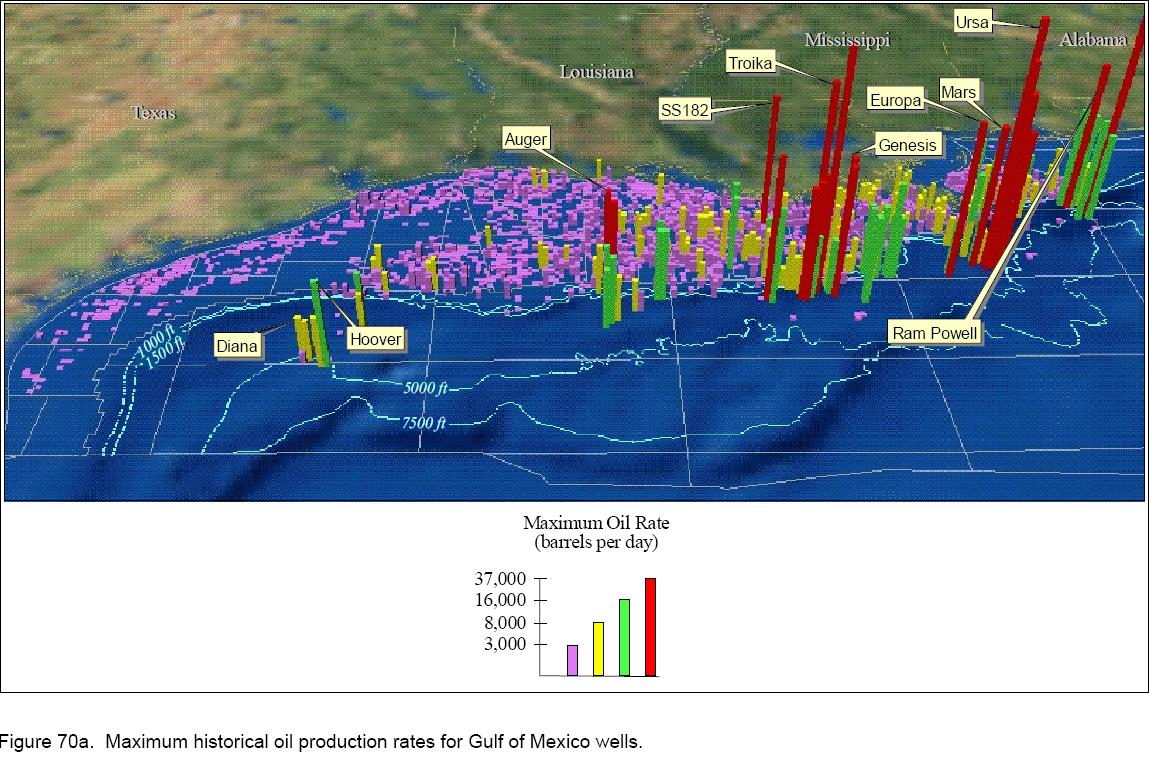
Historical Gulf of Mexico Production Data


I like this image a lot. Found it here. The data is based off 2003 MMS well data, so it's pretty far out of date on the deepwater fields, but it illustrates how deepwater production is the lynchpin of US offshore oil production (the lion's share of the ~1.6-1.8 Million Barrels a day we produce offshore). The chart is organized based off the maximum historical production rate (B/D) by leaseblock. Note that the shallow fields have history back as far as the 1940's, while there are plenty of blocks now (2011) in production that aren't even show on the map. If the map were updated with today's information, it would look even more lopsided.

Wednesday, November 3, 2010

The Landrieu Party?

Random observation from yesterday: Every single office of any significance in Louisiana is now held by either a Republican or a Landrieu. The Louisiana Democratic Party is practically extinct. It should be renamed the Landrieu Party.

(Yeah, there's Richmond, but he might not be around that long)

Friday, June 11, 2010

4 Horsemen Approach South Louisiana?

The demise of South Louisiana has been forecast many times before, but we're now looking at some bleak times.

There is of course the Gusher in the Gulf that just goes on and on, ruining the environment and putting the fisherman out of business. P&J's is hit and almost every single fishing ground in the state will eventually get whacked. So many people in South Louisiana are employed bringing nature's bounty to shore.

There's also the "Economic Nightmare" of the Drilling Moratorium. Thousands of Louisianians are employed working offshore or supporting those offshore (including yours truly) and the rig count is one of the most important factors in the health of the industry. Artificially setting it to zero will have consequences.

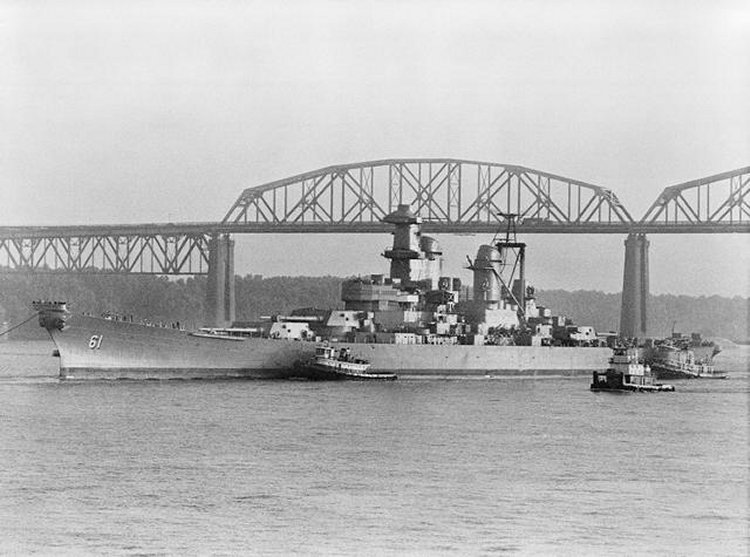
Another factor to consider: Avondale Shipyards is looking at tough times. It was once the largest private employer in the state. As recently as the 90's, it was still the 3rd largest employer in the state. Candice's grandfather was one of the many throughout the tiny Acadiana towns to take the bus to the yard. Business is slowing dramatically and while they're OK for now, there's not much on the horizon to give them hope. From what I understand, it's a mixture of factors. First off, Louisiana doesn't have the congressional heft it used to. Landrieu has some swing, but the rest are pathetic and it's a far cry from the days of Breaux, Livingston, Boggs, and even $Bill. Avondale is also a bit of an old yard. It's main advantage is that it's got access to deep draft waterways (the Mississippi has 3, 100'-deep channels all the way up to about Baton Rouge). Northrup-Grumman, which also owns Pascagula, is looking to shift workers to Mississippi, where they have plenty of work for the foreseeable future and a much more modern yard. Northrup-Grumman may even completely close Avondale. Most of the newer US Navy ships tend to be shallower draft, anyway (most of the capital ships started under the 600-ship navy program are still in service with less of a need for replacements at the moment). Here's a nice photo for old-time's sake: USS Iowa passes under the Huey P in 1982.

Finally, Michoud only has a few more E.T.'s left to ship and is facing big job losses.

Oh well, at least there'll be the lawyers suing BP to support the economy (unless of course, the trial gets sent to Houston)...

UPDATE- Avondale Shipyards to close, according to Northrup Grumman.

Sunday, April 11, 2010

Books on Edwin Edwards

One of the things that always frustrates me is learning history that's too recent for the history textbooks, but before I started to regularly read the newspaper. I've been interested in reading up on some recent Louisiana history and the Leo Honeycutt biography caught my eye:
Edwin Edwards
Leo Honeycutt's "Edwin Edwards"

The book features extensive interviews of Edwin Edwards made while he was in prison. Frankly, the book stinks. The beginning is actually quite good and the book covers quite a lot of non-EWE-related Louisiana recent history, which I appreciated. The chronicling of the media's influence on campaigns is one of the best parts of the book. I also like how much the anti-Edwards camp is exposed as hypocrites (Foster for being pro-Duke, pro-gambling and Buddy Roemer for being the "father of legalized gambling in modern Louisiana"). Towards the end, though, the book became unreadably bad. James Gill was quoted extensively, but only at the end when it served the author's bias. There were a couple of quotes that, when a fuller quotation was given, would have conveyed the exact opposite of what Honeycutt was trying to portray. The book also had some minor typographical errors throughout, but for a first edition that was sort of rushed out, I'll forgive. The blatant pro-Edwards bias ruins the book towards the end. I couldn't finish the book, it was that bad.

Bad Bet on the Bayou: The Rise of Gambling in Louisiana and the Fall of Governor Edwin Edwards
Tyler Bridges' "Bad Bet on the Bayou"

Instead of finishing Honeycutt's book, I picked up Bad Bet on the Bayou. It is a history of gambling in Louisiana from the Louisiana State Lottery Company to the conviction of Edwin Edwards. The earlier history is fantastic. I loved how it described pre-suburbanization Jefferson Parish as nothing but thugs, scoundrels, and prostitutes. Sometimes, you'll hear suburbanites complain about all the corruption in New Orleans, but the shit that went down in the 'burbs is amazing.

Tyler Bridges really stuck it too Edwards. He got a little too preachy at times. His most effective passage was when he chronicled the damage done by gambling addiction to a half dozen Louisiana families.

After reading both books, first off, I would have never read nearly as much of the Honeycutt book had I read Bridges' book first. I'm also ardently anti-gambling and Bridges' book only reinforced my views. The best way to stop gambling is math education, but if we did that, half the state education budgets would be in the red!

As far as EWE goes, I think that Edwards' first two terms were OK, at least he didn't push gambling. His third was crap, but then again, it was the oil bust, so anyone would have had a hard time. Edwards' fourth term, well, I'll let the man describe it for himself:

"The best thing that could happen to me would be to win the election and die the next day"

-Edwin Edwards to John Maginnis, just before the runoff election against David Duke

Wednesday, October 7, 2009

Pelican State Oil

Matthew Simmons is an author and energy investor who happens to give some pretty good presentations. I noticed a new one that had some very important fact I'd like to highlight.

Here's the Presentation [PDF]. It was put together for Acadiana Business Magazine and is all about the Louisiana's oil industry.

As I've pointed out before, there's a huge amount of infrastructure off the Louisiana coast. At least $100 billion dollars in offshore infrastructure. Simmons points out that offshore is the most important "Parish" in the state. The heart of Gulf of Mexico Oil production is in South Louisiana. All of the major support bases and logistical centers, as well as the pipelines and a good chunk of the refineries are in Louisiana.

There are a couple of slides I'll steal that I think are important because they illustrate a point far better than I can in words:

Production Scorecard, From Matthew Simmons

One of the realities of offshore fields is their incredibly short lifespans. They are incredibly prolific for a couple of years and then the pressure gives out and the field depletes. Cognac peaked at 72,000 barrels/day 5 years after first oil. 10 years after that it was 17,000 barrels/day. Today, it's roughly 2,000 barrels/day. Since words don't really describe it as well as pictures, here's a few more slides I'll highlight:


NOTE: Curves from Simmons & Co.

What do the curves all have in common? Quick peaking fields with harsh declines (>10%/year sometimes, 4-6%/year is industry average). Because of that, 90% of the production comes from less than 10% of the fields. There are a lot of platforms out there that are only kept around because their abandonment costs are so high [not entirely true; a lot have extended leases on life thanks to subsea fields or pipeline stations for deeper fields]. Trace amounts of pollutants are one concern (see the Brent Spar for an idea of what I'm talking about), but I think the bigger issue is the hazard to marine traffic. The Gulf of Mexico has two of the biggest ports in the world (NOLA and Houston). Some of these platforms are only a couple thousand feet of major shipping lanes, which is like threading the needle for the really big, really unmaneuverable oil tankers and cargo vessels. There have been some minor collisions and some major near misses, but so far there's been no major accidents.

Another of his points I don't totally agree with: Louisiana's oil infrastructure is very old, which is true, but it tends to be pretty well cared for and Katrina was, in some respects, a blessing in that a lot of old equipment got replaced and upgraded. Rust isn't as big a deal as it could be. He raises the specter of having to rebuild or expand the LOOP. I've heard of the latter, but I've never heard of anyone saying the LOOP was rusting away.

One of the major subjective assertions he makes, that I happen to agree with, is that the demographics of the Louisiana oil industry, in terms of the aging workforce, might be the WORST IN THE ENTIRE GLOBAL OIL INDUSTRY. There's some young engineers that have been hired since the 2000-era boom and some old guys who survived the cutbacks in the 1980's, and almost nobody in the middle. Not a day goes by without more older engineers going into retirement. A company can keep a stable headcount, if you're lucky, but you'll never be able to keep the experience and talent level the same. The oil industry is paying a price for firing so many workers at the end of the oil bust. The business people thought the Gulf was a "Dead Sea" and these workers would no longer be needed. Oops.

Louisiana's oil industry has had several obituaries written for it, but it's not dead yet. When things are said and done, Louisiana will still be playing a major role in bringing energy to the nation, no matter what form that may come in.

Wednesday, August 5, 2009

Louisiana is slipping...

Between New Jersey, Chicago, and South Carolina, Louisiana is losing its street cred. Not even a mention on Stewart:
The Daily Show With Jon StewartMon - Thurs 11p / 10c
Thank You, South Carolina!
www.thedailyshow.com
Daily Show
Full Episodes
Political HumorSpinal Tap Performance

COME ON LOUISIANA! We can out buffoon them!

Maybe Stacey Head and Tracie Washington caught in a bizarre Julie Quinn-esque love triangle! Warren Riley caught doing blow in the evidence room with hookers! Maybe a DNA-encrusted diaper or two?

"When the going gets weird, the weird turn pro..."

Tuesday, April 28, 2009

Oil drips and discharges - 28 April 2009

Here are two articles from The Oil Drum to peruse: Iraqi Oil: Black Gold or Black Hole? and Iraq's Oil: The Greatest Prize Of All ? These two articles go through the reason we went to war in Iraq: OIL. Specifically, how much is there under the dirt. While there are some good prospects in Kurdistan and the Western Desert, it's highly doubtful oil reserves will go much above about 60 billion barrels (half the stated Iraqi reserves).

The more recent article also touches on the challenges of even maintaining Iraqi production rates. The problems break down into a couple of categories:

• Endemic corruption (many of the technocrats that oversaw production have been killed/replaced with politically connected idiots)
• Political reserves (i.e.- lying to OPEC to up their production quota's)
• Bad management (Under Saddam, some of the northern oil fields were "oil-flooded" because the oil was embargoed, but the natural gas wasn't. That leaves a sticky mess that's extremely hard to recover from)
• Political rivalry and foreign oil company stalemates (Iraqi's have a long held mistrust of international oil companies)
• Political insecurity (including rampant violence that's still way to dangerous for international oil workers)

There's also basic phyisics and geology the Iraqi oil wells are starting to run into: Iraqi oil wells are watering out and production set to plummet. The only PSA currently in operation is a Chinese contract, signed in 1997 under Saddam, but even that one will probably soon be abrogated. Without a massive investment (which flat out ain't happening given the violence level and the always looming threat of nationalization), by 2012, Iraq's production will plummet, possibly below a million barrels a day (currently 2.2 MBD-ish - pre-war was 2.5 MBD).

Iraq will start running out of oil about the same time the last of the troops get on a plane to head back home. Nice timing.

How can we drill for oil in the arctic? Well, look at the Sevmorput, a nuclear-powered drillship. Ah, those crazy Ruskies and their Russian reactors.

Did oil prices cause the economic crisis? I've been seeing this theory pop up over and over. While there are structural issues that go beyond the price of oil (like the regulatory environment), as a proximate cause, it deserves some serious consideration. Think of it like the assassination of Franz Ferdinand. War followed, but that was just the spark that lit the fire. The area was packed with kindling before that and was just waiting on a spark, though.

And I'll close with a shiny thing next to some not so shiny things:

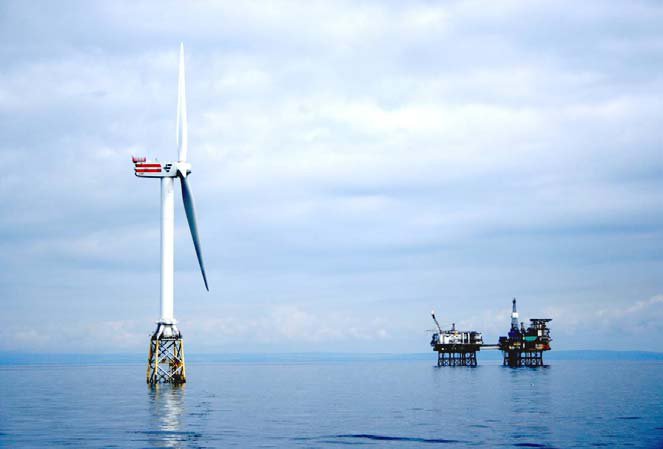
Oil Platform over depleted field sprouting a 5 MWe wind turbine off the coast of the Netherlands. We could easily be doing this off the coast of Louisiana.

UPDATE- I wanted to post more this morning, but was trying to get to work on time.

Here's a bit more:


Why Dick Changed His Mind. Cheney used to be fairly well grounded on foreign policy. What changed his mind was his belief that Peak Oil was imminent and the only way for the US to be successful in the 21st century was to control the largest supply of untapped oil (he thought, Iraq).

During the big push for offshore oil drilling over the summer, I heard some absolutely ridiculous claims about possible reserves off the eastern seaboard. I've come across a couple of scientific studies of the VERY limited drilling that occurred off the Jersey coast.

This article talks about uneconomical gas reserves found in the Baltimore Canyon. Also nice to read because of the discussion of Mukluk.

This is a (dated) but detailed study of the geology of the Baltimore Canyon. Baltimore Canyon won't have anywhere near the oil as, say, Mississippi Canyon or Cantarelle or other big GoM formations, but there's some promising territory there. I'd love to see what modern seismic could do. Just the subsea imaging alone has come a long way. That being said, there's no guarantee that oil found will be developed. All support infrastructure (pipelines, compression facilities, supply ports, etc.) would have to be built from scratch.

3 great photos of the drilling rig replacement operation at Shell Mars TLP. The scale on these photos is hard to wrap your head around, even when I've walked around the deck and peered up that the drilling rig. To think it got lifted up like that is amazing.

Sunday, April 5, 2009

Oil drips and discharges - 5 April 2008

Oil industry narrows focus on deep water. This is bad news for Louisiana. Deepwater Exploration and Production was THE hottest area in the oil biz for the past decade and Louisiana was a big beneficiary of that. Little coastal cities like Morgan City had a sustained boom coming from well-paid oil service workers. Now, it's dropping off a cliff. The oil companies are cutting way back and the service companies are taking the brunt of it. I've heard that the oil service companies have taken a lot of their workers, who had been working 80-hour weeks [paying them handsomely in the process] and cutting their hours down to 32 hours a week. I've heard some service companies complaining it's just the majors trying to squeeze lower rates out of the service companies. Others claim it's fear of what sort of taxes Obama might place on the oil industry. Dunno, just know it looks bad. Morgan City used to have the lowest unemployment rate of any city in the country. Give it a year and I guarantee that won't be true.

Not only will Louisiana start getting hit with lower employment, but lease sales are getting colder and colder. These lease sales are critical to plugging the budget gap and financing coastal restoration. Keep in mind a lot of companies have been sitting on unused leases, so there's little incentive to splurge on new lease sales.

A lot of people are pinning their hopes for "energy independence" on the Canadian Tar Sands. Couple of interesting pieces: Two Canadian Giants merge in an effort to cut costs. National Geographic just ran a huge expose on the tar sands operation. Here's a good roundup of the reactions and articles. Worth clicking through to read a few. Lots of jobs, but at a staggering environmental impact. Don't forget that any increase in oil production will depend on 2 things: cheap heating of steam (through natural gas) and large volumes of water, way beyond what they have access to right now.

Other quick hits:
Why oil prices will rise again. Underinvestment will lead to an energy crunch when the economy gets back on track.

Latest fashion craze in Iraq: buying civilian Hummers. H2's and H3's in bright colors are all the rage. Oh, the irony. On a serious note, rising internal consumption cuts off future oil exports. Keep that in the back of your head...

Volcanos and Oil: a bad combination. Somebody send a memo to Chevron. CC Bobby Jindal.

Why did oil hit $147 a barrel then crash? It might be because of a Goldman Sachs short squeeze. Note to those that want to "blame the speculators" on the entire run up on prices: the short squeeze didn't start until oil was more than $100/barrel.