Showing posts with label Corps of Engineers. Show all posts

Saturday, July 1, 2017

It's already well into hurricane season... Are your pumps working?

Maybe, maybe not.
Image may contain: sky and outdoor
Pump station #3 in St. Bernard Parish near Meraux.  Photo dated June 21st 2017.  

It's not like those pumps are important or anything.

Saturday, December 29, 2012

Gating the Rigolets?

This was on the cover of the paper recently:

I expected a bit better writeup on this very important project.  It's a large levee proposed stretching from New Orleans East to Slidell.  It will have gaps in the channels at the Rigolets, but will have options to install gates at a later time.  

Note that the gating of the mouth of the lake has been proposed on numerous occasions in the past.  Proposals go back at least 40 years.  It's back under discussion, partly because of Isaac's LaPlace flooding. Here's a letter to the editor shortly after Isaac calling for the gates.  

Putting in the levee along the old St. Bernard birdsfoot is a pretty low-risk, moderate-reward project.  In fact, it was even called for in the Corps' original 1962 plan for hurricane protection levees around New Orleans, but was shelved for a variety of reasons including cost.  So long as you maintain sufficient gaps for normal inflow and outflow, there's very little impact on the lake, although there's not as much of a mitigation against storm surge.  The natural tendency is to want to gate off the final gaps, but that could cause problems.  

Gates present problems risk for two main reasons: flow and backside fetch-driven-flooding.  

The first issue is flow.  Lake Pontchartrain is really more akin to a tidal mudflat than a traditional lake.  There are MASSIVE inflows and outflows in that lake on a regular basis.  Even without hurricanes, the tidal flows through the Rigolets can reach ~6-8 knots.  That's really moving.  Any gated structure will mean a choke point which will increase the flowrate much higher.  That means the structure will be very, very vulnerable to scour and undermining.  Here's an illustration of scour at the Rigolets:

Source:
McCorquodale, J. A., Georgiou, I., Retana, A. G., Barbe, D., & Guillot, M. J. (2007). Hydrodynamic Modeling of the Tidal Prism in the Pontchartrain Basin Estuary. Dept. of Civil and Environmental Engineering, University of New Orleans, New Orleans, LA.

This is a trestle bridge that supports the CSX line that runs along the Gulf Coast.  The pilings interrupt the flow and cause major scouring in the vicinity.  Note that scour very nearly destroyed the Corps-built Old River Control Structure in 1973, partly due to a design flaw:
 In 1973, a large flood tested the ORCS to its limits.  Huge scour developed underneath the large steel pilings which anchored the structure to the river bottom. The structure was almost swept away, and emergency concrete was poured into the holes as a kind of large Band-Aid.

Any gate structure in the Rigolets would have to cope with similar, powerful scour effects.  

The other problem with gating the Rigolets is backside flooding.  You'd think that if you just built a giant plug, well, that'd solve all your problems, right?  Like putting up a giant dam, no storm surge could enter and no flooding would result, right?  Not quite.  

A term used in physical oceanography is "Fetch".  Fetch describes how wind (even very weak wind) acting over a large enough surface area begins to build up waves and surge.  Isaac, despite being barely a Category 1 storm, covered a very large surface area.  Despite they eye hitting Port Fourchon, I had friends in Charleston, SC lose power from the outer bands of the storm.  Despite weak winds, they were able to act over a large area and build up a pretty impressive surge, as anyone in Braithwait or LaPlace can tell you.  

How does this relate to gating the Rigolets?  Well, let's suppose you had a continuous, 50' barrier keeping the mouth of the lake plugged up through any and all hurricanes,  you still have the surface area of Lake Pontchartrain that the wind can act upon.  The lake is ~24 miles wide by at least double that width in the other direction.  The surface area of the lake is ~630 square miles.  Even if you have a weak wind, it has enough surface area to act upon to still make a significant surge.  Even if you have gates, you'll still need levees around the edge of the lake!  Gates alone are not enough.  

Purely fetch-driven surge in Lake Pontchartrain can pile up to 6 feet+ on the Lake (Source: Ed Fleming at a presentation I attended).  Furthermore, that surge can be driven North, South, or West, depending on the direction of where the hurricane hits.  For example, a hurricane that hits Morgan City has a north-east quadrant that would drive storm surge to the Northshore.  A hurricane that hits Bay St. Louis would push surge southwards onto the lakeside levees of Jefferson and Orleans Parish.  Note that there are no Federal flood protection levees anywhere on the Northshore and, while they have been authorized for LaPlace, no funding has ever come forward to actually build them.*  Getting around to building more levees, given current rigorous standards, could be pricey.  

My main point is this is a levee project to pay particular attention to.  Especially if the gates are added later as an option.  Gates will have some tricky design challenges and are not a panacea.  


shore_4_low_2_2_2 _____________________
* There was a letter to the editor by David Vitter (note: dead link) where Vitter slammed the Corps for not building the LaPlace levee that was authorized after extensive study in ~1992.  Umm... The Corps is a creature of Congress.  It does what Congress funds.  The LaPlace levee was authorized in ~1992, but wasn't funded.  Who was in charge of securing that funding?  Maybe a politician that's been there representing Louisiana for a decade plus as a Representative and Senator?

Another sidenote: We also need to kill the whole "blame New Orleans levees for Braitwhite/LaPlace flooding" thing.  This was studied and debunked before the levees were built.  They've gone back and double checked it, and sure enough, the New Orleans levee improvements had negligible effect on levees in LaPlace/Braithwhite. UPDATE- This is the link to the Corps study stating the NOLA Levee improvements had no effect.  More here: New Orleans Levees Hold, and Outsiders Want In.


UPDATE 2- I'll just add the recent Bob Marshall Op-Ed about updating the bird's foot to save the coast and help the port here.  Worth a read.

Sunday, August 26, 2012

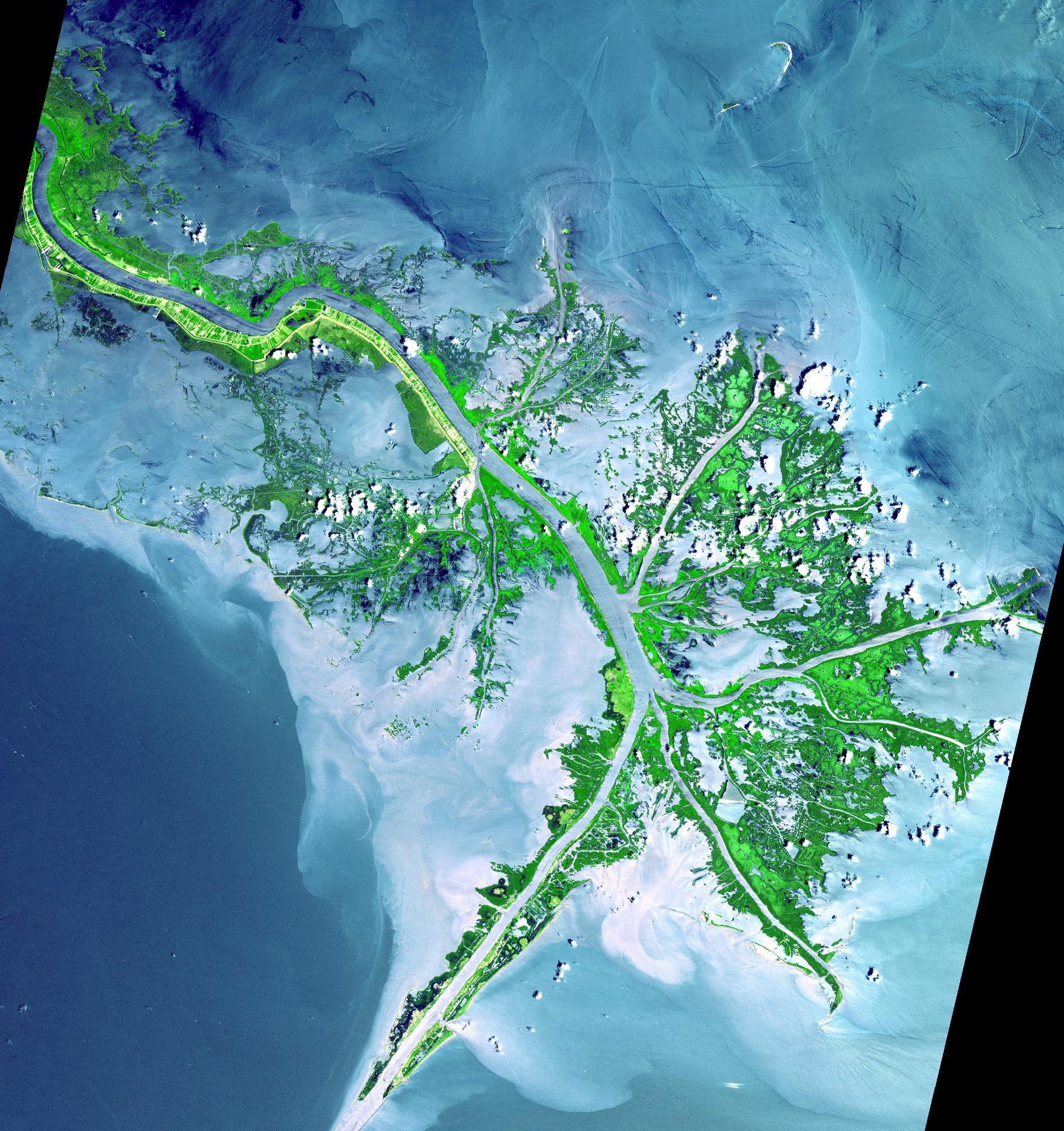
Head of Passes


I want to tie a few different threads together here.  We have the release of Louisiana's 2012 Coastal Master Plan (Large PDF), the expansion of the Panama Canal, the struggles of the Port of New Orleans during low water levels, the BP spill fines, and Louisiana politics.

Mississippi River levels are now so low, barges are grounding (note: this article talks about barges upriver of Baton Rouge).  You can notice all sorts of other signs: if you drive across the CCC bridge, you'll notice extra barges around Algiers Point for lightening the load of freighters coming up the river.  If you taste the tap water right now, they're putting extra chlorine to combat the low levels.  These ultra-low levels happen about once ever 10 years and they are a pain for the Port of New Orleans.  The fall, for whatever reason, tends to be the busiest time of year.  That's also when river levels are the lowest.  Meanwhile, Congress funds the Corps' dredging and asks them to meet 40' depth (which they almost never reach, due to lack of funds).  They allocate ~$500 million dredging (don't worry too much about cost; it more than pays for itself in commercial activity).  The Port kicks in some extra, but in times like this, they always end up ~$50-100 million short of what they really should have to keep the port completely busy.  The other thing is much of that dredging money isn't spent on Southwest Pass (photo below), but instead at Pass a Loutre (a smaller, shallower channel, that, if you ever did a proper economic analysis, it'd say 'dredge more at SW Pass).
Southwest Pass

The capacity of the Panama Canal will double when the expansion project is complete.  Sometime in 2014 (or shortly after), ports that want to recieve traffic will need channels at least 50' deep.  After being caught up in Tea Party politics for years (note: dead link), Florida is finally pushing forward with the Deep Dredge project.  The Port of New Orleans had a great opportunity to leapfrog Miami and now their window of opportunity may be closing.  Meanwhile, Boss Hogg's plan to renovate Gulfport into a Superport has fallen apart (note: dead link).  Fortunately, Slabbed has been on the case.

It would be great to kill 3 birds with one stone: restore the coast, promote shipping, and protect New Orleans from hurricanes.  There's coalescing around a plan to abandon the lower Bird's Foot, divert the river, and also have a newer, shorter route to the sea for shipping.  Dr. Renfro's got an article along those lines here (also, congrats on finishing the PhD; I saw her present at a past TEF as just a PhD student).  The diversions will also continue to work, even without constant infusions of major cash (unlike dredging).  So, that's what we NEED to be doing.  What are we doing instead?

Well, first, we're fighting over the BP spill money.  There's also a fight to chip away at the few wetland protection laws there are.  Louisiana Legislators want to raid the BP money for use on their own pet projects instead of spending it on coastal projects.  Fortunately, we seem to be doing OK at beating that idea back.

Fishers and dredgers oppose Coastal Master Plan.  Unfortunately, I see a drift away from the "Engineered Avulsion" idea and towards dredged sediment restoration.  What's so bad about dredged sediment diversion?  Well, first off, what is it?  It's when you dredge a bunch of sediment, put it in a particular place, and it promotes further land growth.  Here's an example:
One of the problems with dredged sediment restoration is that it actually does work.  The reason that's a problem is it's expensive, it's a one-shot thing (you have to do it over and over) and it only works for a limited area.  

Dr. Bahr liked to call the dredging industry, "Louisiana's Military-Industrial Complex."  He has a point.  They donate tons of money to politicos, have a protected market that's not open to free trade, and just sort of sit there and make money with no innovation.  The dredgers love dredged sediment restoration, because it's money in their pocket.  The fishermen love it, because it has no impact on fisheries.  The problem is it's just not going to be enough.  It's a proverbial band-aid on a gunshot wound.  I'd hate to see the initial billions go to dredging, none to restoration, and then having to come up with remaining dough ourselves.

So, we have a fight between doing what's needed to save the state from sliding into the ocean (and making the Port of New Orleans a Superport) or in the short-term putting a few nickels in a politically-connected pocket and continuing with business as usual.  Which way will it go?

UPDATE- gCaptain article about keeping the MS River dredged.

Wednesday, August 8, 2012

Corps-Created Sill Gives NOLA Fresh Water


Every late summer/early fall, Mississippi River levels fall.  Less snowmelt and (this year especially, given the big drought) lead to a battle between the ocean and the river.  Saltwater, which is more dense than freshwater, crawls upriver along the riverbed.  To ensure New Orleans, Belle Chasse, Chalmette, etc. have potable water, the Corps of Engineers constructs a sill.  Just north of Myrtle Grove, dredging creates a sill that is only a few feet tall and is invisible to the casual observer (it never pokes above the water).  Despite that, it acts as a dam and ensures that the salinity of the freshwater intakes in the municipalities never exceeds acceptable levels.  It's not 100% effective; some saltwater does seep past, but it's never a problem for municipalities and industrial users (like boiler make-up water) can rent reverse osmosis units to keep it to acceptable levels for their use.  

The sill may be invisible to the naked eye, but here's a sonar image of the sill (from Meselhe 2005):


Just another part of the civil engineering that keeps the world humming every day.

UPDATE: Mike Schleifstein Writeup

Wednesday, October 26, 2011

West Bay Diversion to close?

West Bay Diversion Project to End. Or at least, that was the headline in early 2010.

Backing up, West Bay was the first diversion project optimized for sediment diversion. It's also WAY larger than either Canarvon or Davis Pond (ea. ab. 10,000 CFS vs. 50k+ for W. Bay). Canarvon and Davis Pond are sometimes called failures, but that isn't really fair, since they were optimized to fight saltwater intrusion only and NOT to carry sediment.

West Bay is located near Head of Passes (scroll down on the link for the maps). Planning started in 1991 and it was the first diversion optimized for sediment diversion. It was opened and petered along for a while, but was considered a disappointment. The Corps, who hated the project from the start (they believed it would be a hazard to navigation or would just plug up), trumpeted the failure and pushed for its closure.

Here's a quote from Dr. Len Bahr about the Corps and West Bay:

Despite its recent construction in 2003, bathymetric surveys in 2009 showed that sediment accretion from the West Bay Sediment Diversion project had exceeded subsidence in parts of the project receiving area for the first time in almost a century. Nevertheless, the public was told that a lack of significant wetland accretion contributed to a decision to shut down this ‘youthful’ sediment diversion project.

They also forced CWPPRA to pay for the dredging of the Pilot Town anchorage, despite modeling that proved West Bay was responsible for 20% (or less) of the shoaling and that the anchorage was built in an area that was prone to shoaling anyway. Here's a presentation from a past Tulane Engineering Forum describing the sediment transport modeling [PDF]. Furthermore, the port people weren't really complaining because the anchorage is hardly ever used (pilots are almost 100% available within a few hours notice at Head of Passes; the anchorage is almost a vestige of the old sailing days).

Enter the 2008 and 2011 Mississippi River floods (both of which were BIG, especially 2011 which was at least a 100-year event). West Bay, which wasn't a total failure like the Corps was making out, but also wasn't lighting the world on fire, explodes in activity and they figure out the missing ingredient: sand and gravel. The normal river flow has almost no sands in it; it's all mud and fine sediment (good for nourishing plants, but not enough of a base for land-creation). In flood events, there's a totally different dynamic. During flood events, sediment load per unit volume of water is at least 50 times larger, with much coarser sediment mobilized. The Corps continues to call West Bay a failure.

There was also an interesting side story that happened about this time: CWPPRA was investigating barging sediment from one area to another and asked the Corps about shortcutting through the West Bay diversion instead of going all the way around to SW pass. The Corps said, 'bah, it'll be too shallow and you'll just get stuck on a sandbar and we know everything there is to know about river dynamics because we've been studying it for 100+ years.' Well, the barging project was shelved because of cost, but they did to a hydrographic survey and the depth of the West Bay channel: 84' (barges draw ~20' or less).

More and more, the science community wants to study West Bay (being wrong in science is a good thing; you learn something new). The Corps is doing what a bureaucratic organization does to something it sees as embarrassing them: kill it with fire. The Corps had finally blackmailed CWPPRA into closing West Bay in 2010 when 2 monkey wrenches were thrown into the mix: the 2011 floods and the shipping people 'stabbed the Corps in the back' (or so that's how the Corps felt, so I'm told). Note that that link is dated October 13th.

My theory behind the objection: the port people know SW Pass is hydraulically inefficient and a pain to keep dredged. They're looking into a new, deeper pass much closer to Venice and see West Bay as an interim solution to accommodate New Panamax-class ships (Panamax=39.5' draft, New=49.9' draft) in a cost effective manner (as opposed to Miami's expensive Deep Dredge Project that's caught up in Tea Party-type stalls). The Port of New Orleans has been doing extremely well with containerized cargo this year (highest ever for NOLA?) and want to get an even bigger slice of that pie going forward.

How will this all shake out? Will the Corps force the closure of West Bay? Will we ever learn how to save the coast? We shall see.

Sunday, September 18, 2011

Review: "The Big Uneasy"

I missed the chance to see The Big Uneasy premier at The Prytania and a lot of other opportunities since, but felt it was pretty important to watch it. I downloaded it off Amazon and just finished it and here are some of my thoughts.

The Big Uneasy doesn't cover a lot of new ground that a local that's read the paper won't know, but it's good to know that a lot of it will reach a wider, national audience. It did a great job of some of the more qualitative issues (addressing "Why don't we move New Orleans?" in their "Ask a New Orleanian" segment), but I was a bit disappointed when it came to some of the more technical aspects. I may have had high standards, but I expected more.

One of the things that constantly annoyed me was little glitches. For example, there's a progression where they show land loss from 1932-2010, but the graphic is wrong. They pulled the graphic from Blum and Roberts (or some derivation thereof, like the Mike Schleifstein writeup) and the progression should have ended in 2100, NOT 2010.

There's another screwup where they're interviewing Ivor van Heerden and he's talking about building on sand horizons in the London Ave. Canal and he's talking about water seepage through sand and he says that sand is a bad foundation because it's not strong enough. Well, actually, sand is a pretty good foundation. It can withstand a pretty hefty load without subsiding, when compared to many other layers you'd encounter in South Louisiana. Now, the larger issue that Ivor was talking about is absolutely 100% correct (water seepage through sand) and that was his main thrust of his excerpt; the structural point was sort of an (irrelevant) aside, but because the editor left the whole interview unedited, it sort of makes the subject look (to technical eyes) like he doesn't know what he's doing, when he (at least in this case) does.

I'm probably being nitpicky, but I'm an engineer and that's just what I'm gonna do. One of the things I was really disappointed in wasn't what was in the movie but what was left out. When talking about LSU, Sean O'Keefe's is never mentioned. There was no real mention of the actual structure of the Army Corps of Engineers (military officials that come and go while 90+% of the Corps are civilian engineers, etc.). Dr. Bob Bea is big on organizational issues contributing to disaster, well, wouldn't it be great to ask Dr. Bea (who had worked at the Corps back in the day) about leadership churn at the Corps?

Another issue is the dynamic between Congress and the Corps. They made the point over and over that the Corps is Congress' pet and they had one good example where they went through all the Congressional websites highlighting all the water-resource bills various congressmen have corralled. I would have like to have seen them go a bit further there.

I'll even lay out a great example for somebody to take: dredge companies. I'd love to see someone look into crooked dredge companies. There are examples out the wazoo. For example, on one coastal restoration project, the dredge company was paid per cubic yard of material dredged, but not on what actually made it to the build site, so they could lose all the material they wanted between Ship Shoal and the deposit site and there was no contractual mechanism to penalize them.

The best example of all on how crooked the dredge companies is the River Dredge Wheeler. Wheeler was commissioned in 1982 after being designed from the keel up for one purpose: keep Southwest Pass open. It was a purpose-built tool designed to maximize efficiency and minimize cost for a very specific purpose. Since it's commissioning, it's been almost entirely unused. It sits in "ready reserve" most of the time next to the ACoE headquarters at Riverbend. You see, back in the early 80's, a group of congressmen (including Bob Livingston, you can fill in the rest of the 'usual suspects') got elected and decided that "the government is obviously incompetent and let's let the free market do everything!" Now, they couldn't just lease the Wheeler to a private operator; that wouldn't result in enough political donations to the politicians. So, they decided to let it out to private dredge companies. Then, embarrassingly, nobody bid; it was too big a job for even a consortium of companies. The Corps then went back, sliced and diced the dredge job into small tranches that private dredge companies could tackle (with huge project management staffs to keep track of everything). This highly inefficient system continues to this day. A few years back, a Dutch company wanted to bring in some ultra-modern dredges and do the job much cheaper than the local companies could do with their antiquated equipment. The dredge companies then squealed like stuck pigs for government protection ("GAH! Jones Act! National Security! DEY TOOK ER JERBS!"). The Dutch, who had plenty of work building the Palm Islands in the UAE dropped their inquiry after a while.

On a related note, after Katrina, there were scores of letters to the editor demanding to "privatize the Corps." What would a privatized Corps actually look like? Wouldn't you still have to have some sort of project management staff to oversee the whole mess?

Dr. Bea does make the excellent point that the Corps no longer has as large a technical staff and that lots of personnel are now outside contractors and a lot of those who remain are more project managers than competent technical professionals. That is, frankly, a criticism you could extend to many, many other industries. Contractors and subcontractors and consultants are a major feature of any heavy industry today. I will say this: you can pull up Karen Durham-Aguilera's CV shows a P.E. licence and a technical Master's. The Vicksburg office of the Corps is still a center of excellence in geotechnical engineering. OTOH, I've also had interactions with Corps employees who couldn't set up a free-body-diagram to save their life.

How 'watered down' has the Corps become? I'm not sure I have an answer, but I'll put forward an idea. On projects I've worked on, when there's a really immense challenge and there's no time to argue over budgets or organizational hierarchies and you get the MBA's to just stand out of the way and let the engineers 'do their thing,' you'd be astounded with the results. In virtually every measurable metric (LTI's, delivery time, and {counter-intuitively} cost), these "Apollo-program" projects outperform the day to day engineering jobs we put together. There's total, bottom-up efforts to get it right. It's very similar to Scott Adams' "Bet on Engineers" philosophy (WSJ Op-Ed here).

The Corps is closed to finishing a major effort to get New Orleans' levee system up to 100-year protection as quickly as possible. How did they do along the way? Well, there are some good things they've done and some not so good things. The Ms. Garzino's faulty pump incident is quite worrying (updated letter here). So is the ongoing issue with debris in some of the levees (and what annoys me the most about that is the immediate 'shoot the messenger'-reaction as opposed to 'gee, maybe we oughta enforce these contractual requirements and penalize some contractors'-reaction). There's also the question of workplace atmosphere that was brought up by the Levees.org personal attacks on company time issue. I think a commander of the Corps has more to fear from fostering a workplace environment of, say, sexual harassment, than one where technical competency is valued and a good engineering product is turned out.

In the end, the Corps is a big bureaucratic organization. They're not the only one who's had a major engineering disaster, but we'll have to see how they respond. Do they build a better organization or do they fall into the same old traps? It hasn't been settled one way or the other and the proof will be in the pudding (what gets built and how it holds up). I will say this for the critics of the Corps: they only responds to INTENSE criticism. The Corps doesn't really get tact and nuance. You have to whack them in the head with a sledgehammer to get their attention.

Keep paying attention to Levees.org and Fix the Pumps.

NOTE- Small edits for grammar and spelling.

Friday, April 15, 2011

Notes on the 2011 Tulane Engineering Forum

I got a chance to attend the 2011 Tulane Engineering Forum and the forum continues to grow. This year drew over 600 engineers. The day before I went, one of my coworkers teased me that going to an engineering conference hosted by Tulane was like going to an easter egg hunt hosted by the Ayatollah in Tehran*.

One of the things I've really come to like about the TEF's are that I'll pick up on some really nice phrases/wordplays/sayings. Some of my favorites from this year:
* "Worry Budget"
* "Assumed-Away" (dealing with risk)
* "Science as a contact sport" (engineering as well, sometimes)
* "Compartmentalized engineers" (missing out on the big picture)
* "Dynamic Regulation" (constantly in-flux regulatory rules that are poison for projects that take 10 years to develop) {Another quote from the same guy, "[MMS] served our industry well for a number of years"}
* "Everyone supports it, until you put your finger on a map" (coastal restoration)
* "Engineering meets public health meets Indiana Jones" (Engineers Without Borders)
* And my favorite of the year: "Unavoidable uncertainty in complex systems" (talking about scientists dealing with the public on complex topics)

This year's theme was the Macondo blowout. I attended the Morning Plenary Session (which included a dispersant expert from XOM, a ChemE professor from LSU, an MBA from Tulane, and the head of research for ULL), but ended up attending mostly coastal restoration and infrastructure lectures. My personal favorite lecture of the day was given by Dr. Allisha Renfro who pinch-hit for a presenter who was out. She did a science and engineering postmortem on 3 coastal projects: MR-GO**, the West Bay Diversion, and the Myrtle Grove Pulsed Sediment Diversion (which was held up as a model for future projects).

__________
* Maybe he read this article?

** Even if you ignore all the "secondary" effects (levee failures, wetlands loss, etc.), MR-GO was a MASSIVE failure on its primary objective: serve commerce. Taxpayers ended up subsidizing MR-GO (from its opening in 1968 to its closure recently) by $20,000/vessel, clearly a massive failure in its primary objective (lower transportation costs). There was also plenty of science, engineering, and economic expertise that warned against the project before it was ever begun, but the powers that be pressed on anyways.

Last year's forum notes.

Thursday, August 26, 2010

5 Years of Keeping Up With the Corps

17th Street Canal Visit
In the five years since the worst failure in the history American Civil Engineering, we've had to keep up with the Corps. They've done some good things since the storm (MR-GO closure, quick and strong repairs) and some not so good things (Option 1 vs. 2a/b debate for permanent pump stations). I'd like to go through 5 major ideas that, depending on how they settle, will determine what sort of levee system we end up with.

1- Design/Build. Shortly after the storm, the Corps decided to issue most of their contracts as Design/Build instead of the Design/Bid/Build, which they've used for decades. Nobody is really sure why the Corps is doing this. I've heard arguments from the Corps saying that they'll get more "creative" designs. I've heard arguments elsewhere saying that the Corps wants someone to throw under the bus in case there is another failure. The Corps also didn't initially free up any money for bid prep work, which meant that bidding firms would spend as little as possible preparing for the bids and would go with very conservative designs they knew how to estimate the cost of. Design/Bid/Build allows you to work the kinks out of the design while still on the drawing board. It's a hell of a lot cheaper to pay a few engineers overtime than have hundreds of workers and field equipment idle while you have to redesign something in the field once construction has begun. In general, I think the design/build approach will lead to excessive cost overruns, but won't make a difference one way or the other on the quality of the work.

2- Resiliency/Backup. One of the points the SELFPA-E has repeatedly made to the Corps when arguing for work on the interior canal walls is what happens if there's a failure of the interim control structure. I have no reason to think there is a design flaw, but if there was, then the flood waters would have a direct path into the city where we know that certain sections of the floodwalls are sub-standard. If the walls are repaired, there would be a second line of defense. The Corps has said that there's no money to do repairs to the existing walls and they can only do what Congress orders them to. The Corps wants to focus all their efforts on Option 1. Now, I will give the Corps credit because there have been several promises made to do at least a modest amount of work upgrading the canal walls at known weak points and that has at least partially mollified SELFPA-E's worries about the canal walls. There is some recognition within the Corps that redundancy is a good thing. OTOH, the Corps can shift some money around and it sort of pokes a hole in their "we do what Congress orders us to do" argument, because otherwise, they wouldn't spend a nickel on canal wall upgrades. From what I understand, it looks like there will be minimally acceptable repairs to canal walls, but many engineering experts, particularly the SELFPA-E would prefer to see more.

3- Geotechnical Analysis. Southeast Louisiana is built on very soft soils and the geotechnical analysis of what sort of loads it can carry is key to any large building project. Most of the geotechnical engineers I know do not believe the Corps' geotech methods are the best that are out there. Furthermore, while I can't say this about the Corps, I have personally seen geotechs put under enormous strain give a "better" answer to allow projects to move forward. The last thing I'll say about geotechnical engineering is it's one of those things in engineering that's still sort of art mixed with science. MIT did a famous study that was presented to ASCE where they constructed a dike, gave a group of eminent geotechnical engineers every single detail about how it was constructed (fill material, depth, volume, etc.) and asked the geotechnical engineers to provide an estimate of how high the water level inside the dike could go before the dike gave way. Of the 7 experts, 5 gave predictions significantly below the level that it failed at, 2 gave level substantially above the level it failed. The geotechnical engineers were given perfect data and no political or economic considerations factored into this test.*

4- B.31.3 Calculations. Matt McBride covered this a few years ago: Post 1 and Post 2. Later, Parsons wrote a report [pdf] that stated the piping is properly designed, per ASME B.31.3 code. It doesn't happen often, but I can say absolutely, definitely, objectively that they are WRONG! I've done those ASME calcs many times before and they are just plain wrong. The consequences aren't all that severe (the piping would probably leak, causing a drop in pressure and lower pumping rates; very small risk of rupture/HSE danger), but it still worries me. If there's a mistake that obvious in something built to tight tolerances, what about more subjective engineering decisions that use materials with wide tolerances?

5- 100 vs. 1000 year protection. As Tim has repeatedly pointed out, "100 Year" protection isn't enough. We need 500 or 1,000 year protection. Furthermore, I have personal questions about how those 100-year levels are computed. The Corps, in the post-Katrina work, has actually built a bit higher than strictly to 100-year protection. For example, some levees have a few extra feet to take subsidence into account and ensure that in a decade or so, the levees will still be well above the 100-year level. Outside the government, I've seen other organizations that have completely revamped what they consider to be a "100 year event". For example, offshore, what used to be considered a 1000-year design is now only considered a 100-year design and as a result, modern construction methods are much, much more robust than they were even just 5 years ago. Don't take my word for it. "Lessons Learned the Hard Way" Page 11 [pdf]: "Yesterday’s 1000-yr criteria have become today’s 100-yr". You can also compare the old API RP's with API 2INT-MET (subsequently integrated into current API RP's).

From all this, I hope everyone sees how important it is to keep an eye on the Corps. Oversight is incredibly important. Note that the SELFPA-E is spending an enormous chunk of their incredibly meager budget to get engineering firms to review the Corps design drawings and calculations. This is important work that must continue.

UPDATE- Minor edits for spelling.
___________________
* Paper: "Reliability of embankment performance predictions" Hynes and Vanmarcke, 1976.

If God Willing and Da Creek Don't Rise

Spike Lee came down and blasted a shotgun at New Orleans. His camera caught the good, the bad, the guilty and the innocent. The main feature of Spike's documentaries is the expansive, if schizophrenic coverage they provide.

Here are a few thoughts:

My absolute favorite part of the entire thing was how they covered the plight of the elderly. More than whites or blacks the elderly had it the worst of anyone. Too many stayed in their homes in Lakeview or elsewhere. They had ridden out Betsy and Camile and just weren't evacuating. Too many drowned in their homes. Many more just had more change and chaos than they could take. So many just lost the will to live, more than any physiological illness.

From there, the rest of the film is a mix of the good, the meh, and the atrocious.

The coverage of the levee situation is atrocious. Ivor van Heerden and Brad Pitt are levee experts and Ivor says the reason the Corps is building things right is because the trial lawyers are on their ass! The Corps is given very little chance to speak (for good or for ill), and Dr. Calvin Mackie (the first black engineering professor at Tulane), who was sterling in "When the Levees Broke" dismissing dynamited-levee-conspiracy-theories, was not really referenced.

Good job on covering mental health issues.

The most questionable part of Spike Lee's style is who he decided to put in the film. It's a very mixed bag. John Kerry? Tracie Washington and Brinkley do not speak well to Spike Lee's judgment. Fuck Brinkley. Fuck anyone who wants to put a camera, mic, or pen in front of him. In his horrible book, the "Great Deluge", he writes that in 1927, they blew up the levees to flood all of the black people in the Lower 9th Ward. Nope. That's how shitty a historian he is.

IMMENSE smackdown of Warren Riley, et. al. by General Honore for panicking people about snipers and raping babies. Honore showed real leadership (unlike, say NOPD) and put his body in front of panicky soldiers with loaded rifles and told them to stand down and realize they were in an American city. As a post-script, I've been told they later realized that the alleged "sniper" near Charity was the PVSV popping off relieving pressure on a liquid oxygen tank used for the hospital.

Schools, meh. Would have liked some mention that the School Board was in the process of being flushed down the toilet before the storm.

Crime & NOPD. Man, what a disaster.

Nagin and the history question... Nagin was allowed to talk way too long and say way too little.

Ivor is also an expert on mining and oil and gas safety...

Tracie Washington is an expert on Dispersant

The BP part, meh.

Thursday, May 13, 2010

The F-N Diagram

I was going to do a bigger post on this, but I've sort of let it slide, but I didn't want to completely forget about it.
F-N Diagram
From here: Managing Risk to Humans and to Floodplain Resources (PDF). The chart shows chance of a levee breach on the vertical axis and number of fatalities on the horizontal axis.

When this chart was put up at the Tulane Engineering Forum, the audience took a second to process it (note the log-log scale), but when they did, there was a gasp. It's not every day you see a graph of fatalities on a logarithmic scale. Each line is 10 times worse than the line preceding it. You don't want to see the New Orleans levees in the upper right quadrant of this chart.

The big point I was going to make in the long post I never wrote was we need MUCH more than 100-year level levees.

Related: Residual Risk / YRHT. Very good quote from Dr. Bea.

More here:
Risk-based design of flood defense systems (PDF).

Remember, hurricane season is less than 3 weeks away.

UPDATE- Some minor edits.

UPDATE 2 - Presentations Online

Saturday, April 17, 2010

Notes on the 2010 Tulane Engineering Forum

Got a chance to attend the 2010 Tulane Engineering Forum yesterday. It's been evolving into the most interesting engineering conference in the city. There's a good chunk of the city's P.E.'s that attend it every year, including lots of business owners. There's also always at least one presentation every year on the state levees. Partly because of the technical proficiency of the audience, you get some extremely in depth and thorough debate.

Last year's introductory session {PDF} was given by the Corps and I'm told they spent the whole time praising all the things that are being fixed up and all the good things the Corps has done. I'm told that there was some interesting back and forth at the end of their presentation, but I don't know the details, so that's all I'm going to say about that for now.

This year's presentation was by Dr. Dalrymple, Dr. Bolard (PE), Dr. Christian (PE), and Dr. Reed. They were a part of the National Research Council's team that worked for the Corps on LACPR, basically the task force that Congress appointed to design "Category 5 Levees."

As we all know, to date, there is no solid plan for Category 5 Levees. The most up to date thing the Corps came up with was a "menu of options" (111 in total) that was slammed when it came out. The Corps, despite billing themselves as the premier coastal engineers in the country, left it up to Congress to make the ultimate determination of what would get done. While there are some political implications (see Oyster's post), the panel went through some of the scientific and engineering challenges that also pose problems.

First to present was Dr. Dalrymple. His main points were the lack of a "sediment budget" for the lower Mississippi River. The loss of sediment load and sedimentation action is the #1 coastal loss issue, according to him. This was one of his slides:
Sediment Load
Source

As a side note, if you were to poll the top 100 coastal Louisiana experts on what the biggest problem is, probably 95 would say either canals, primarily for oil and gas exploration, or sediment loss, primarily due to levees confining the Mississippi River. When you have someone from the Corps speak, they tend to play up the canals and when someone from the oil industry speaks, they tend to play up the sediment loss. All four presenters, while nominally affiliated with the Corps, were heavily into the sedimentation camp.

Dr. Dalryrmple went on to comment about to designing a "Category 5 Levee" system. It would be more accurate to describe what New Orleans needs as a 400-1,000 year level of storm protection. No matter what is built, some local cooperation is needed for non-structural mitigation strategies, such as zoning, building codes, and buyouts.

In the end, Dr. Dalrymple held a fairly pessimistic view of the future. When asked what was the NRC's influence on the Corps' plans, Dr. Dalrymple described it as "subtle." The audience of engineers nervously laughed.

Dr. Bolard was the next to present. He once again railed against the failure to take advantage of sediment, both with beneficial use of dredged materials and how we're still directing the majority of the sediment load that comes past the city off the continental shelf into hundreds of feet of water. 125 Million Tons per year of sediment are wasted in this way. Dr. Bolard pointed out that all of the plans from the Corps assume that we'll have basically the same coastline as we do now in 50 years, despite the fact that we lose 24 square miles of coastline per year and that trend has been more or less unchanged for 80+ years! The bulk of Dr. Bolard's remaining presentation was a complicated discussion of the Corps' attempt at using MCDA to whittle down the 111 plans into one or a few actionable items. He described the multiple attempts as failures, for a variety of reasons.

Dr. Christian was next to present and he had by far the best presentation of the group. I'll actually skip over most of his presentation because I want to come back to it in a later post. He mostly talked about the "600-lbs. gorilla in the room: the Corps' performance before during and after Katrina." He started off by listing things that Corps has done into 3 categories: things that have been blamed on the Corps, but aren't really their fault, things the Corps has done well, and thing the Corps has done "not so well."

On the things the Corps gets blamed for, but isn't really their fault, he claimed: split responsibility, Louisiana politics, and a few other minor things. He gave one example of a specific floodgate that has 5 different entities "controlling" it (railroads, roadways, the local levee board, and the Corps). He said that they looked up the operation procedures of each of the organizations and each one assumed that someone else would close the gate in the event of an approaching storm! Also, Louisiana's political scene doesn't do us any favors nationally when hunting for funds to build the levees.

Dr. Christian's list of things the Corps does well were Task Force Guardian, IPET, and the Corps' hydraulics and hydrology understanding. He particularly singled out the Vicksburg office for their understanding of hydrology.

Dr. Chrisian's list of things the Corps does "not-good" was pretty scary. First, he says that all too often you'll have a representative from the Corps, say that the Corps has never had a failure. He says that if you put enough modifiers and adjectives in there, you can get a strictly factual statement, but, in the end, THE LEVEES FAILED!
490px-NOAA_Katrina_NOLA_17th_Street_breach_Aug_31_2005
NOAA via Wikipedia

It's sad to say, but the Corps failed, the Corps failed, the Corps failed. He said it needs to be drilled in that the Corps' levees failed from Katrina's glancing blow under stresses far below their design capacity. The Corps-built levees resulted in the worst civil engineering disaster in American history. Dr. Christian was adamant that that fact not be overlooked in any way.

Dr. Christians other two serious criticisms was the Corps' geotechnical and soils analysis, especially with the New Orleans office is fundamentally flawed. He said that was his professional opinion and that he knew there were lots of people with the Corps that would take strenuous objection to the statement. Note that the debate safe water level in the outfall canals has been extremely contention because of just this issue.

Dr. Christian's last "not so good" Corps procedure was that peer review, while successfully implemented under TF Guardian and IPET, has become a "box-check" and not a real concerted effort. Getting any information out of the Corps is like pulling teeth and there's outright hostility to "outsiders" looking over the Corps' design process.

Dr. Christian made a lot of bold statements, but between the slides and his response to engineers' questions, he seemed to back them up, IMHO.

Dr. Reed was the last one to present. She spoke of the need to manage flood protection, navigation (remember, the reason New Orleans exists), and coastal restoration. We managing the lower delta (where to chop it off) is the big issue for the next 50 years. We don't have the sediment load to preserve everything that exists today, so we need to do some triage. She also mentioned that Mississippi is extremely concerned with any effort to gate the mouth of Lake Pontchartrain because of its effects on Mississippi Gulf Coast storm surges (probably increasing them).

Where does all this leave us? One attendee who saw both plenary sessions (2009 Corps and 2010 NRC/LACPR) described them as presenting "quite a different picture." Currently, we have no plan for Category 5 Levees. The Corps says they'll come out with a plan 'this summer,' but we'll see if/when it comes out and if it's just another "menu" of options. The full presentation will also eventually be uploaded to this page.


NOTE- Minor edits. Also, Dr. Christian praised the Times-Picayune coverage of the situation. He says they've done a better job of informing the locals of the challenges facing the city than anyone has ever given them credit for (and it's not like they've been ignored).

UPDATE- Looks like Mike Schleifstein made it. His article looks along the same lines as mine, but I've got a few more details and he's got a few more links. Also, he caught that the new due date for "Category 5 Levees" is July. I just caught summer.

UPDATE 2 - Presentations Online

UPDATE 3 - The Corps' summer plan is out and it's yet another "Menu of Options"

Thursday, November 19, 2009

Chalmatians and 9th Warders have their day in court

"In a landmark decision, a federal judge has ruled that the Army Corps of Engineers' failure to properly maintain a navigation channel led to massive flooding by Hurricane Katrina" from WDSU.

Here are a few notes and thoughts:

From the CS Monitor:
"The government's primary defense is that what we did, it did not cause this, and if it didn't cause it, there is no liability," Mark Davis, a professor at Tulane University Law School, told the Monitor this summer.

The LA Times talks about the monetary award a lot. It notes it will be years before appeals are exhausted, but the compensation could total billions. Note that this ruling would only apply to residents of Chalmette and the Lower 9th Ward. Also from the article:

He called upon the Obama administration and Congress to agree to a universal settlement -- something he said the Bush administration had pledged not to do.

O'Donnell said his team had filed a separate legal action that seeks to cover those thousands of victims in a class-action suit. He noted that the federal government had agreed to universal settlements in past cases in which it had erred, including after a 1976 failure of the Teton Dam in Idaho and the 2000 Cerro Grande fire in New Mexico, which started as a federal controlled burn.

I looked up the Teton Dam failure and found a few things that interested me, like, "On Saturday, June 5, 1976, at 7:30 a.m., a muddy leak appeared, suggesting sediment was in the water, but engineers did not believe there was a problem." Also, on the cause of the dam failure (emphasis mine):

Study of the dam's environment and structure placed blame on the collapse on the permeable Loess soil used in the core and on fissured (cracked) Rhyolite in the foundations of the dam that allowed water to seep under the dam. The permeable Loess was found to be cracked. It is postulated that the combination of these materials allowed water to seep through the dam and led to internal erosion, called piping, that eventually caused the dam's collapse.

From the American Society of Civil Engineers Report on the 2005 New Orleans Levee Failures:

Known soil stability problems played a big role in both with a very similar failure mechanism between the outfall canal failures and the Teton Dam failures. The best thing about the Teton Dam failure:
Today, Bureau of Reclamation engineers assess all Reclamation dams under strict criteria established by the Safety of Dams program. Each structure is periodically reviewed for resistance to seismic stability, internal faults and physical deterioration.

Gee, it would be a nice idea to try doing that for levees.

I still think this ruling will be overturned on "sovereignty immunity" grounds, but it's always nice to reinforce to the rest of the country that had the Corps simply designed and built the levees to spec, most of New Orleans' flooding would never have happened and we'd all be talking about how New Orleans 'dodged a bullet.' If you want to see a natural disaster, go to Buras, LA or Waveland, MS.

UPDATE- Harry Shearer weighs in. Oyster provides quotes from a judge with quite a lexicon.

Tuesday, October 27, 2009

Quote of the Day - 27 October 2009

Storm threat to New Orleans out of our control, says general | World news | The Guardian


"If you ask can I protect the city, the answer is no. Can I reduce the risk? Yes. "We can develop better early warning systems, better evacuation plans, better levees to hold back most of the water, but we cannot stop levees being overtopped and the city flooded." He declined to say whether this meant the city should be abandoned altogether and relocated inland. "That is outside my brief," he said.


Thursday, September 17, 2009

Maria Garzino Interviewed by Harry Shearer

Harry Shearer interviewed Maria Garzino, the whistle-blower who first pointed out how flawed the M.W.I. pumps were. I listened to the show and took notes and just wanted to share a few random observations. You can listen to the interview for yourself here (Sunday Sept. 13th Show).

Ms. Garzino did give a few conflicting statements over the course of the interview, but not an unreasonable amount, given it was a 30 minute interview on a technical subject.

* An error on the ACOE pump support structure drawings caused the pumps to be installed with 2' less of NPSH(a) than the pump impellers were trimmed to. Ms. Garzino thought it was not an unusual error, given the complexities of the project. It took a while to correct, but it eventually was fixed.

* The "battle test" that the ACOE is so proud of for the M.W.I. wasn't much of test at all. SCADA data shows that the M.W.I. pumps were only run once the heavy lifting was done by the direct drive pumps. For background, all major industrial equipment is controlled by Programmable Logic Controllers (PLC's). These primitive, reliable computers communicate to each other through several different protocols, one of which is SCADA. It's still a little hard to get definitive evidence, but it seems to be backed up by the runtime reports at the back of the Parsons Report (Table 3-10, etc.).

* One of the serious design flaws that kept the M.W.I. pumps from being successfully tested was air getting into the hydraulic pumps. In the M.W.I., diesel engines turn a hydraulic pump. That hydraulic pump pressurizes fluid that runs through lines to a hydraulic motor. The motor turns the impeller blades that moves the water. The reservoir that fed the hydraulic pumps was mounted incorrectly, causing air to carry into the hydraulic pump. Air in a hydraulic pump bad, on a good/bad scale. It tore the guts out of the hydraulic pumps. The reservoirs were mounted higher, to avoid air undercarry. That solved that particular problem.

* Maria Garzino then described the various stages of whistle-blowing she went through. She brought it up with various folks within the Corps. After she exhausted internal appeals, there was an Internal Technical Investigation by the Corps. I believe that was done by the Vicksburg office. She said the report was nice and all, but it didn't set its own scope and didn't really address her concerns. The Parsons Report followed on with more or less the same issues. Finally, the Office of Special Council hired their own technical advisers, went through all the reports and basically agreed with her over the Corps. Here's a letter [PDF] that describes a little more about the OSC report.

* Another issue she went through is how her actions changed some of the Corps plans. The Corps was, at one point, planning on re-using the M.W.I. pumps in the permanent pump stations. Later, the Corps decided that the M.W.I. pumps were only temporary. I don't know if there's any way of knowing whether the Corps had the original intent of using the Corps for the permanent stations, but I can say that they got lots of pushback from all sorts of sources when they discussed re-using the M.W.I. pumps. Mrs. Garzino's actions may or may not have contributed in the change of plans.

* The Corps has a developed a "How To" manual for reworking the Interim Closure Structure (ICS) into a permanent facility. The price tag on ripping out the M.W.I. pumps and replacing them with direct drives is approximately $275 million dollars. According to Ms. Garzino, the original estimate that the Corps submitted to Congress included a 50-year design life for the ICS. Spending $275 million after you told Congress that what you built had a 50-year design life is a waste of money. It's not completely an apples-to-apples comparison, but I think it's still useful to mention that large offshore oil structures have a design life of 35 years.

I listened to the radio interview to make some sort of judgment on Ms. Garzino's credibility. I listened like a hawk and took notes and while there were some contradictory statements, her interview taken as a whole leaves me to conclude her story is quite credible. All of her major assertions check out.

UPDATE- More things are coming to me in bits and pieces:

* The Corps really moved the chains for M.W.I. to pass the tests. Some of the moves were no big deal, but others were not legitimate. When competitively bidding contracts, you have to hold the winning bidders to what they said they'd do, especially with regards to testing. It violates ethical engineering practices and its unfair to the losing bidder. I understand the Corps' complaint (that they were under the gun for time), but the Corps is not the first entity in the world to face a looming deadline for a major, complicated project. If the Corps asked for testing the pumps, M.W.I. should have had a line item of a few thousand per pump for testing. If they didn't and they won the bid because of that, they should be forced to eat the difference. Remember, there's hardly ever only one vendor that can provide a piece of equipment or service.

* Verifying the pumps against their curve (making sure they work as the salesmen claim) is an important step. Hydraulic Institute standards state no worse than +/- 5% of the curve. Hydraulic Institute standards are MINIMAL; I can tell you that most clients I've dealt with have much more stringent standards on the pumps they test. If it's just a $50,000 pump or so, you're probably not going to bother testing it. Millions of dollars worth of pumps? You're going to get them tested. For critical systems, like de-ballast, firewater, etc. you're going to test the pumps to the Nth degree with a good chance of additional factory inspections.

* M.W.I.'s salesmen may have made excessive claims, but its the duty of the engineers not to just take them at their word and verify what they say. I worked on a job about a year ago where an engineering company bought some pipe for a pump discharge that wasn't pressure rated. I talked with the engineer and he said the salesmen said it was "an ideal application." I talked with the salesmen and he he told me it meets certain AASHTO, etc. specifications. I looked up those specs and the first thing they say is that these standards are meant for non-pressure rated pipe. The ratings the specs give were minimal 20 foot of head (~10 psig) ratings that should never have led an engineer to use them as force-mains. It's the engineer's job to run these things down.

Tuesday, September 8, 2009

Floodgate Reports - The Bottom Line

I've had a couple of posts in the hopper while waiting on some last few pieces of information. I'm going to break into that info early, because I think it's important...

Two major levees-related news items today:

Analysis finds flaws in pumps at outfall canals. (Refers to M.W.I. Pumps)

Corps revises London Ave. Outfall Canal ICS operating procedures. The big news is that the safe water level has now been reduced so low (about 2.5 feet) that the pumps will now run during all major rainfall events.

What does this mean in the big picture?

The current setup was a temporary fix based off what the Corps could assemble as quickly as possible after the storm. (From Page 10 of Parson's Report)

The interim setup, even if every single pump operates flawlessly to its full design capacity, is only designed for a 10-year (UPDATE- "rain") event. We've heard many times how much of a joke the 100-year level is. The 10-year level is even weanier.

Pumping Station #6, which feeds the 17th Street Canal and is the main pumping station for the city of New Orleans, is capable of putting out a little over 10,000 cfs. That's an admitted shortfall of over 20% at that pumping station. In a big enough storm, water will begin to back up. In a short/lightish storm, the only thing that will probably happen is street flooding and maybe a few flooded cars. In a long-lasting/high-intensity storm, large parts of the city , especially Gentilly (drained by PS#3 & #4), Mid-City and Lakeview, will flood.

The parts of the floodwalls that failed were repaired quite thoroughly. The Corps rebuilt those parts with T-walls with ample foundations. But, the parts that didn't fail were left untouched. There's been a about what the safe water level for the Canals is. Each time the Corps has investigated, the walls have been derated. The walls SHOULD be rated to their top (a little over 10' elevation). Instead, they've been derated, especially on the London Avenue Canal, where they'll now close it at 2.5'**. There are currently no plans whatsoever to rebuild the walls or repair them in any way. The Corps says it would take too long and would take too much money and they'd rather get the permanent pump stations online.

If you were to sit the major engineering experts in the area down and ask them what the 3 most important projects are for New Orleans, I'll bet the lion's share would include the permanent pump stations at the mouths of the outfall canals. When the "10-year storm" standard was adopted (~ early 2006), the Corps was planning on having the permanent pump stations in place no later than 2010. Had they been replaced then, the 10-year storm standard may have been reasonable. Now, they're officially saying it will be complete by 2012, at the earliest. The Corps has picked up the pace, but it's looking more like it will be 2013 at the earliest before the stations are complete. The longer it takes for the permanent pump stations to be built, the more maintenance will be required and the more one should question the original design basis for the pumps.
NOLA Pumping Stations
Bottom line: The pumping capacity of the City of New Orleans is seriously constrained. Sections of the city, especially Gentilly, Lakeview, and Treme/7th Ward, WILL flood in storms significantly less intense than the minimal 100-year level we expect, even without a levee breach. The extent of the flooding will be proportional to the storm intensity and duration. The system will not be fixed for several years at the current rate. Major weakpoints in the system (the weakened walls) will still not be fixed by the time the system is complete.

I hope that sums things up without droning into too much detail.

________________________
* I'll leave the "contractual" issues for others to comment on, I'll stick with my expertise. From what I understand, the Corps basically called around to see who could supply the most cubic feet per second (cfs) by next hurricane season. That particular time, because of rising commodity prices, was a bad time to be buying heavy equipment, especially pumps, especially pumps that large. I'll give the Corps the benefit of the doubt and say that, among those they contacted, MWI had the most cfs with the quickest stated delivery.

** Safe water level used to be about 5' with closure at 4'. Now it's 4' with closure at 2.5'. The Corps has said they will take whatever measures necessary to stop the level from rising in that Canal, including shutting off all pumps feeding the canal until their pumps can catch up. It's already happened several times. The canal walls have been derated so much, I'd curious how they justified the decision to give them any rating whatsoever.

PS- Thanks again, Matt McBride. Fix the Pumps is a great reference site.

NOTE: Some minor edits after initial post.

UPDATE- See comments.

UPDATE 2- London Avenue floodgate closes today (9/12) due to heavy rainfall.

Friday, April 10, 2009

Keeping watch on the Corps - UPDATED

As hurricane season begins to emerge on the horizon, here are a few articles for you to ponder about the Corps and the levees.

Temporary pumps at Orleans, London and 17th Street canals safe, investigation shows. Parsons, one of the largest engineering firms in the world, was tasked with evaluating, for the n-teenth time, the MWI pumps that have been the source of much controversy. Parsons declared the pumps, within very limited parameters, the most important of which is the speedy replacement of the temporary pumping stations. The Corps originally planned on 2012, but now is planning on 2013. Any delay past that could have serious consequences. Two final notes: first, the link to the full Parsons report (here [PDF]) is now broken, last time I checked and second, I may post more on the Parsons report. If anyone would like a copy of the report, I still have a copy of it in PDF format. I'll just say for now I have some issues with Parsons' report.

Obama appoints new overseer for Corps. We'll see how this plays out. She seems to be more of an environmentalist than some of her predecessors, which might play well for Louisiana's coastal restoration needs. We'll just have to wait and see.

Jury deliberating on Corps bribery scheme. Two contractors for the Corps tried to bribe several Corps employees for confidential bid information to allow them to get a leg up on the competition.

Corps hurricane chief leaving New Orleans. Heading to Afghanistan after a short rotation in New Orleans.

ASCE internal investigation finds to ethical misconduct. Please note Tom Jackson's comments at the end. He's an extremely well respected engineer and New Orleans is lucky to have him as the head of the Easter Levee District. Levees.org responds: Levees.org calls probe a "whitewash." I hear the news reports of the conference and they claim that ASCE only investigated one specific complaint out of a 40+ page long letter. I haven't seen the letter posted any where yet, so I'll reserve judgment until I see it. UPDATE- Here's the letter [PDF]. Hosted on the Louisiana chapter of ASCE's website. It also looks like two sets of complaints are being conflated. One complaint is by Dr. Seed (link above). The second complaint is by the founder of a well respected local geotech firm, Dr. Boutwell, that recently passed away. Those complaints seem to be well known and well understood. His report centers on the precise mode of soil failure.

Ivor Van Heerden fired by LSU. This report is really a mixed bag. Tim and Greg have a long history of extremely justified criticisms of Van Heerden. I tend to like his overview of the geology angle and how he breaks complicated engineering matters down for a lay audience. That's one of the reasons the press has latched on to him. His book, The Storm, still has one of the best described, most detailed reports on what needs to be done to fix South Louisiana before it falls into the sea. When Van Heerden stuck with what he knew (primarily geology), he was excellent. His problem is he made himself too much the story (probably with certain members of the media egging him on) and when he did that, he overshadowed some very good work being done by the Hurricane Center, specifically the storm surge modeling. If he lets himself be part of the story more than the science, he probably needed to go. LSU constantly tried balancing academic freedom with pulling Van Heerden back to his core area of expertise and eventually decided it was easier to just fire him. Still, this firing will probably be a black mark on LSU's academic reputation.

NOTE- Updated. See above. Will probably post more later.

UPDATE 2- I realized I've read through Dr. Boutwell's presentation before (part of which is available on this website). His stuff is very straightforward and well supported. As a result, his report was well received and respected.

Dr. Seed's letter is a different animal. My first reaction to the letter was unprofessional. I don't know what audience the letter was intended for, but he was overly dramatic with his presentation of various facts and down right conspiratorial at several junctures. He brings out the Twin Towers investigations, which could be aimed at a very specific, legitimate failure modes that weren't detected on the initial investigations, but could also be conspiracy-theory crap. Injecting irrelevant information like that jeopardizes the credibility of the entire letter.

All that being said, he made some very legitimate observations about Corps behavior that warrants attention. It looks like several specific employees (not named, but described) didn't discharge their responsibilities in an honorable manner. It honestly reminds me of the Corps employees caught leaving threats on the Levees.org website. The Corps is a large organization, so some bad apples are probably inevitable. The Corps should move quickly to discipline/fire the offenders. I'd be very curious if any of the employees mentioned in Dr. Seed's email are the same ones leaving the Levees.org comments.

It's a shame that the press is conflating legitimate, scientific inquiry with disreputable comments. It casts a shadow over all those investigating the Corps and lessens the impact of legitimate, scientifically verifiable complaints.


UPDATE 3-

Working link for the Parsons report.

Leaking Metairie Levee. Several investigations into underground canal in Metry. Corps says the problem isn't serious. The engineer with the Levee Board-East says there's not enough data to make a definitive conclusion one way or the other.

2 convicted of bribery in Katrina levee case | National | Chron.com - Houston Chronicle One of the guilty had to be taken out on a stretcher after he had a heart attack at the ruling.

I've done a little digging and I have one more point: that's the second Corps commander we've lost in a very short time. Usually, they have a 3 year rotation. This is the second one we've lost after only about 6 months on the job. Frequent leadership changes can be a sign of an organization in chaos.

Thursday, February 26, 2009

Estimating and Procrastinating

"Keystone Corps" Estimating. The Corps doubles their estimate for the cost to gate 'the funnel.' For all the Times-Pic goes on about the estimate, this one might not be their fault. Honestly, this is an incredibly difficult task right now. I've been involved in writing some detailed estimates for big projects and you either have to be so conservative you'll scare the client or you have to try to explain legitimate cost overruns. Commodity fluctuations since Y2K have made it very hard on estimators. For example steel prices shot way up, affecting piping prices. Industrial pipe (SMLS and ERW) reached the highest price they've ever been, but have slowly been declining since August. I wouldn't be surprised if the Corps estimate didn't take into account steel price changes. By the time they actually get the budget corrected, I wouldn't be surprised if steel prices have dropped enough (thanks to the Financialapocalypse) to keep things in line.

FEMA's Toxic Bureaucracy. CBS alleges Bush-era appointees are intentionally delaying reconstruction projects to ensure personal job security in their $100,000+ benefits government jobs. Who is this Doug Whitmer character and why is he still running the show? Cao and Louisiana's only useful Senator are calling for an investigation. I'll say two things: if they go for a full investigation of FEMA contracts, they're going to turn up some VERY interesting things with some VERY interesting connections. Not necessarily ones you might initially guess. Second, this article makes a some anecdotal stories I've heard within the local engineering community over the past 2 years make a lot more sense... I'll just leave it at that.

...Let the investigating begin!

Tuesday, February 10, 2009

Matt McBride's latest letter regarding the Corps

Yet again, permanent pump stations delayed

Dear New Orleanians,

Just about three weeks ago, at the January 22nd Permanent Pump Stations Industry Day presentation, the Corps told contractors and the public that they would be awarding the design-build contract for the lakefront permanent pump stations in the first quarter of 2010. One can see it on page 26 of the slides shown at that presentation:

https://acquisition.army.mil/asfi/upload/W912P809R0013/ACESlidePresentation22JAN09.pdf

It was also on a list of future contracts, issued less than two weeks ago on January 30th (see bottom of page 6):

http://www.mvn.usace.army.mil/hps/Jan30_2009ContractingReport.pdf

Now, on a contracts page that is updated more frequently than the PDF version above, the date of contract issuance has been quietly moved back yet another quarter, to the second quarter of 2010. Scroll down to the very bottom of the main Corps hurricane protection contracts page to see the date for contract PCCP-01:

http://www.mvn.usace.army.mil/hps/hps_contract_info.aspx

Or click here for a direct link to the permanent pump station contract page:

http://www.mvn.usace.army.mil/hps/contractdetails.aspx?ParentRID=98

Both pages - revised on February 5, 2009 - have the second quarter of 2010 as the contract issuance date.

This is how the Corps subtly moves the goalposts without making a stir. And before long, projects are pushed back so far it seems like they will never be built. Will they ever explain this latest delay? I doubt it.

Matt McBride

Friday, January 23, 2009

Keeping up with the Corps

A couple of articles about our ongoing levee upgrades have caught my interest

Levee work must wait years for study. Near the strip of land between Lakes Pontchartrain and Borgne. It would be far more efficient to focus efforts on gating the other end of Lake Pontchartrain at the Rigolets and Chef Pass. That will be one of the big 3 projects that determine the long term future of New Orleans, the other two being the closure of MR-GO and a huge diversion of the Mississippi River along the lines of what John Barry suggested at Rising Tide.

Corps sticks with its plan, despite pressure from shipping interests.

Work underway on MR-GO closure.

I actually haven't worked on any Corps work, but I in the same office as those who do. While this is just sort of a feeling that shouldn't hold any weight, it feels like the pace has picked up in the last 3-6 months. It's like things are finally starting to move forward. Did a fire get lit under someone's butt when they saw the waves lapping over the top in Gustav? Dunno.

The Corps looks like it's taking serious steps to protect the city. Kudos to them.