Wednesday, November 7, 2018


Sunday, October 28, 2018
Building the Panama Canal
"America can do anything it sets its mind out to do."
Wednesday, December 27, 2017
The Deindustrialization of South Louisiana


Louisiana's largest industrial employer up until very recently was Avondale Shipyard. I recently read a book, The Yard, by Michael Sanders, that was primarily about Bath Iron Works, but talked quite a bit about how healthy Avondale at that time (2001) in comparison to the other Navy shipyards. I half expected the book to end with the closure of Bath and success of Avondale. Avondale had the cheapest labor pool of any of the major naval shipyards, had large facilities, and out of all the naval shipyards had the best track record of doing commercial/nongovernmental work. One would think that those advantages would keep the yard open.
Unfortunately, as we all know Avondale Shipyard closed. There's still a very small amount of engineering and drafting work being done at Avondale, but it's pretty much closed. Recently, the floating drydock was towed away (for scrapping?) in South America:

Without that floating drydock, Avondale will never be a real shipyard again. That drydock has a side that drops away and allows for large vessels to be onloaded, floated out, and gently launched in the water. Launching a big ship the old fashioned way (via a Ways) is too risky and too complicated to do for large vessels in as tight and congested a waterway as the Mississippi. Building a new drydock would cost at least $50m on top of acquisition costs for the shipyard. I heard a rumor Huntington Ingalls is asking $40m for the site; the Port of New Orleans, one of the few potential buyers heard that price and laughed.
Why did Avondale close? There's always a plethora of reasons for something big like this (many detailed here), but a few I'll touch on are first off, the general downturn in naval shipbuilding (after the buildup of the 80's combined with the demise of the Soviet Union, just not as much of a need), the demise of the domestic shipbuilding industry after the elimination of Tittle XI of Commercial Differential Subsidies in 1981 (more here and here in Chapter 10 of "Staying Afloat"), the failure to adopt more modern construction techniques (Avondale was actually the first US shipyard to install an automated panel-line welder, but later lagged in the adoption of "Group Technology" shipbuilding practices), and the consolidation of the industry. That last one is the final nail in the coffin, as Avondale and Pascagoula were both owned by Newport News Shipbuilding [Northrup Grumman] and as there was less work to go around, the corporate parent picked which child it wanted to live and which to let whither away.
Pascagoula also had an added advantage in that last fight: Pascagoula was awarded nearly $2B to rebuild after Hurricane Katrina; Avondale didn't get such an award [but did have significant disruption to its workforce housing in Katrina]. Taxpayers basically bought Huntington Ingalls a brand new shipyard. If you could only keep one shipyard open, which would you choose: the brand new, modern, efficient one or the old one that has airdraft restrictions (bridge height)? There was a GAO audit against Pascagoula and they didn't get to keep all of the $2B, but they kept enough to make the difference.
The other major industrial employer in South Louisiana that used to employ nearly as many as Avondale (at least when times were good) was McDermott's large fabrication facility in Amelia, Louisiana. The Amelia facility started in 1956 and went on to build some of the largest and most complicated offshore structures of anyplace on earth. It actually outgrew its first location on Bayou Beouf and moved further down the bayou. When times boomed, it'd be end to end jackets spread over hundreds of acres with thousands of workers.

Being attached to a highly cyclic industry, the workforce size rose and plunged with the price per barrel, but McDermott seemed to hold onto enough talent during the busts to be the quickest on their feet when the boom returned. One example of how I've heard is the McDermott side of the story of the American Queen. Everyone hated working on the American Queen. The vessel was actually built mostly on spec by McDermott without a really firm contract up front. The fab yard never really wanted to become a shipyard (oil patch and shipbuilding being dissimilar enough), but the management knew a boom would later come and wanted to hold onto as many hands as possible. Suppliers got pushed around and annoyed, workers were ridden hard, but eventually the ship was finished in 1995, just in time to clear the yard for Shell's series of TLP's mostly built at McDermott (whose hulls were built overseas and generally integrated to the Topsides elsewhere). While it was a rough project that McDermott didn't make a profit on, the boat filled timesheets and a lot of folks learned good lessons from that project. The American Queen didn't do well under the first operator, who went into bankruptcy, but the new owner is doing quite well, so I've heard. It seems that American tourists are too terrified of getting beheaded by ISIS to go on Danube cruises and are sticking closer to home.
So, it came as some surprise when lots of rumors of the Amelia Fab yard's closure started to come out in the early 2010's. Oil prices were still well over $100/Bbl. But, McDermott, who used to be the top name in offshore fabrication had been slowly supplanted by Kiewitt Offshore Services (KOS) in Ingleside, TX.
One of Kiewitt's keys was the HLD (Heavy Lifting Device):
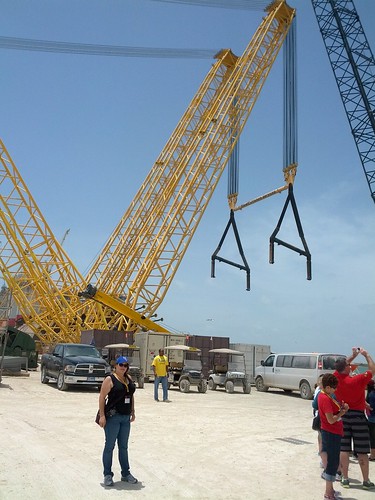
Engineers should never be allowed to name anything because HLD is a horrible name; the largest crane in the Western Hemisphere should have a cooler name than that. The HLD allowed the lifting of bigger, more complete modules for deeper water, more complicated platforms. One story I've heard is that the HLD was actually a "design in a drawer" that originated with McDermott engineers, but management didn't have the vision to see the market and balked at the pricetag. Those engineers quit, convinced Kiewitt to enter the market with a substantially lower, innovative bid that beat McDermott to win one project and Bullwinkle Constructors LLC (a limited liability corporation Kiewitt partnered in) was later converted into KOS.

McDermott Amelia's days were numbered as the rumors turned out to be true. McDermott shifted its operations to Altamira Mexico, where they've hired a thousand workers this year, even in a down market. Their New Orleans engineering office was also shuttered as everything consolidated to Houston.
The upswing of a sustained oil boom are over. The state now has a hangover with massive job loses (in fact, Houma-Thibodaux currently has the fourth most depressed economy in the nation (ranked by census tract), TOPS perennially teetering on insolvency and the state's budget is in shambles. What comes next? Does everyone just pack up for Houston? I sure as hell hope not. What comes next is we get up, figure out what comes next, and do it.
Update: Chouest predicts 2018 will be yet another slow year. Chouest is one of the last medium sized industrial manufacturers left in Louisiana.
Upperdate: Minor corrections for clarity and spelling.
Tuesday, December 26, 2017
Thucydides

A primary source can be "unpolluted" by later interpretations and sometimes, the first opinion is the right one. I've always been fascinated by Alcibiades. I remember when I first learned about him in my classics course at BFHS how amazing it was that he was sentenced to death (sometimes multiple times) by each side in a 3 sided war. I almost admired him for that. After reading the Thuycidides, I have a much harsher opinion of him; he was an aristocratic scoundrel from the beginning betrayed Athens multiple times. Thuycidides is almost completely unsympathetic to him.
What I learned in Thucydides was how universal a few things about the human condition really are. "We'll be greeted as liberators" and "it will be a cakewalk" and "the oil will pay for everything" are slogans that could be used in a hoplite war as easily as a modern war.
The other thing is how durable democracies can be. Athens suffered defeat after defeat after defeat and as the text closes (Thucydides' account of the final battle has been lost to the ether of time) still stands (wobbly) on it's feet. The autocracies in the book could never withstand the body blows that Athens endured.
Athens ultimately lost the war, but in a way, the war was just a battle; the war of logic and critical thinking was ultimately won by Athens.
Friday, May 19, 2017
Monumental
"I think it wisest not to keep open the sores of war, but to follow the example of those nations who endeavored to obliterate the marks of civil strife, and to commit to oblivion the feelings it engendered." - Robert E Lee
Sunday, April 30, 2017
View of Cemetery Hill at Gettysburg
I decided to kind of do a 1 man reenactment of Pickett's Charge. I started near the Virginia monument, walked through the valley of death between Seminary Ridge and Cemetery Hill, then ended up near the Copse of Trees and the High Water Mark of the Confederacy. It's approximately the same route as Lo Armistead. He was one of the few Confederates who made it to the Angle and through the first of 3 Federal Army lines. There he was fatally wounded. As he lay there bleeding out, he asked the Union officer who captured him how his best friend, General Winfield Scott Hancock was doing. The Union officer happed to be Gen. Hancock's Aide-de-camp and informed the dying Confederate officer (erroneously) Hancock had been struck dead. General Armistead expired.
Hancock was wounded and survived and would later become one of the first presidents of the NRA.
What struck me the most on my walk was how exposed I felt. There was no cover whatsoever and high ground everywhere. To attack ~8,000 dug in troops with ~15-20,000 (the later figure includes the artillery) across that ground was a suicide mission. I completely understand why Gen. Longstreet was nearly insubordinate in his attempts to get Robert E. Lee to change his mind.

Friday, April 28, 2017

Friday, April 22, 2016
20th Maine
The extreme left flank of the 20th Maine at the Battle of Little Round Top.
The 20th Maine regiment, under the command of Col. Joshua Chamberlain, held off two regiments from Alabama, exhausting their ammunition supply. Out of ammo with the Confederates massing for another push, Chamberlain called for a wheeling bayonet charge that shattered the Confederate attack and captured large numbers of opposing infantry.

Gettysburg
View from the McMillan Woods towards Cemetery Ridge. 15,000 troops under General Picket charged the US Army under General Hancock.
General Longstreet, the Corps commander was so convinced that the attack would fail, he bordered on insubordination trying to convince Robert E Lee to call off the attack. When it came time to issue the order, Longstreet was in tears and only nodded his head.
Pickett's division was slaughtered by rifles and canon fire as they slogged uphill over open, exposed ground.
Virginia Monument in the foreground.

Friday, November 21, 2014
B-29
FiFi, of the Commemorative Air Force, is the only flightworthy B-29 in the world.
Bock's Car (which dropped the atomic bomb on Nagasaki) is preserved at the Air Force Museum in Dayton Ohio and the Enola Gay (Hiroshima) is preserved in DC, but none except FiFi are flightworthy.
Photo taken at Lakefront Airport.

Monday, July 23, 2012
Piper Alpha: The worst disaster in the history of offshore
Many years before Macondo, there was a much more deadly disaster offshore in the North Sea.
Piper Alpha was the largest platform (by production) in the world in its era (317,000 barrels/day, peak). It was built in the North Sea by a consortium run by Occidental and Dr. Armand Hammer.
I recently picked up Fire in the Night: The Piper Alpha Disaster by Stephen McGinty. The book was only published in 2008 (the incident happened in 1988), so enough time has passed to be able to sort things out.

In addition to time, the Piper Alpha incident had the benefit of the Cullen Report (summarized here), which is a Royal Inquiry. In the US, we have this pesky thing called the 5th Amendment, which protects people from self-incrimination. Under a Royal Commission, they just do away with that. Someone doesn't want to talk, they just lock them up until they feel like spilling the beans. Lord Cullen never had to actually do that to anyone, but I'm sure having a bazooka in your pocket, as Secretary Paulson once said, doesn't hurt.
There were many, many lessons learned from Piper Alpha that are now standard on offshore operations today (SSIV's, Temporary Safe Refuges, etc.). One of my favorites is intumescent paint:
It expands, forming an insulating layer that keeps major structural items intact long enough for an evacuation. In Macondo, 10 people on the drill floor died basically instantaneously. Only 1 person died after the initial explosion (a crane operator who fell and was incapacitated and later burned). All others were able to make it to a safe refuge and the Deepwater Horizon stayed structurally intact for quite some time (~36 hours!). There's actually some disagreement out there as to whether it was the fire that finally killed the rig (high temperature weakening of steel), or the haphazard firefighting dousing the wrong areas in water and flooding the hull (ballasting down the ship, causing it to capsize).
One sad parallel between Macondo and Piper Alpha was the confusion that all too often accompanies disaster. In Piper Alpha, loved ones waited at a hospital in Scotland. One by one, helicopters would land and there would be those who would find out their loved ones made it. Eventually, there were no more helicopters and the families were notified that's all the survivors. Sadly, for another two days, some clung to a rumor that a 'Russian freighter' had picked up most of the rest of the crew and was steaming to a port with the radio broken. Some of the families even drove up to the port to wait on a freighter that would never arrive.
In Macondo, noted fuckface Jiff Hingle, Sheriff of Plaquimines Parish* spread a rumor that a survival capsule was found and contained all of the 11 missing. MSNBC** and Fox News reported that as fact. One of the widows was actually on the phone with her husband's employer getting the news her husband would never return when she saw on the news the report and went on and on about how "he's alive" while the TO employee was patiently trying to explain that the report was false and he died on the rig. Also, both the UK, under a Socialist Prime Minister, and the circa-2010 MMS had almost exactly the same Inspector:Platform ratio.
In the Piper Alpha disaster, Fast Rescue Crafts were worth their weight in Myrrh. My favorite part of the whole book was the story of the Silver Pit's FRB. It pulled more people out of the water than anyone else. It made several 'easy' rescues early, but then took an absolute beating later on when it edged in near the inferno to pick up survivors. They have a load of 3 survivors on board, 4 crewman on the boat, including the coxswain. The boat is leaking and the motor is starting to sound like it's on its last legs. The coxswain spots someone directly under the inferno waving for help. The platform was collapsing into the sea and just the heat flux from the fire that close would give you bad burns, but the Coxswain asked his boatmates, "...Are we going to go? We're his only hope."
The response was a chorus of "GO!" The coxswain puts the throttle down, they go in full speed and with no margin for a second run or even slowing down (with the inferno over their head and the platform literally coming down in pieces all around them) and the crew grabs the swimmer out the water and pulls him in to safety. He survived, despite bad burns.
The FRB goes back to its mothership, offloads survivors, then despite massive damage, wonky engines, and the boat sinking underneath them, it goes back out to try to rescue more. The FRB was all used up from their antics and sank beneath their feet. The coxswain bobbed in the North Atlantic satisfied he had done absolutely everything possible to save people. The final death toll was 167 with only 61 survivors. 33 were rescued by the Silver Pit's FRB.
There is one direct link between Macondo and Piper Alpha: The Tharos / Deepwater Marianas. The Tharos was a dive support vessel that someone billed as an 'offshore fire engine' on the side. It had some design defects and didn't save as many lives on Piper Alpha as it probably should have. It later got converted to a MODU. That MODU spudded (started the drilling) of Macondo. It on the scene for both Piper Alpha and Macondo.
________________
* Source: "A Hole in the Bottom of the Sea" by Joel Achenbach, page 44
** Source: "Fire on the Horizon"
Wednesday, December 7, 2011

Sunday, July 3, 2011
Bunch o' Book Reviews
Here are a whole bunch of quick reviews (with covers from Good Reads):

The Making of the Atomic Bomb by Richard Rhodes.
Loved it. Exhaustive technical coverage of the making of the bomb. It teaches lots of physics and project management. I wish I had read this book when I was in college. Rhodes has a writing style I really like. I've picked up Dark Sun and The Twilight of the Bombs. I've read Twilight of the Bomb and that one covers more of the political side (although the part where the IAEA tracks down the pieces and parts of Iraq's nuclear program is fantastic). Nuclear Renewal is dated crap and is to be avoided.

Lords of Misrule: Mardi Gras and the Politics of Race in New Orleans by James Gill.
Fantastic. A must-read to understand New Orleans history and why New Orleans society is structured the way it is. There was a speech in one of the last Treme episodes where the old plutocrat describes how each successive generation tried to keep the next one down ('until the Standard Oil men left for Houston').

One Hundred Days: The Memoirs of the Falklands Battle Group Commander by Sandy Woodward.
The Falklands War was a surprisingly nasty little war that everyone has sort of forgotten about (partly because the US was incredibly embarrassed by it; the Reagan administration loved the staunchly anti-communist Junta and the Brits, of course were Robin to our Batman). Woodward gives a lot of credit to the 'Argies' ("We should have realized a country that made great Formula One drivers also made for great fighter pilots"). Had the Argentinians either waited for the British to scrap their carriers or waited for the assembled fleet to fall apart from rust and overdue boiler maintenance, they would have won.

Between Silk and Cyanide: A Codemaker's War, 1941-1945 by Leo Marks.
Candice read it and then got me to read it. It's all about SOE's operations and field ciphers. Note that you always hear about Bletchley Park's cryptography, but never allied codes (except for maybe the Navajo codetalkers); that's because the allied codes were crap. One of the German cryptographers wrote a book about "Operation North Pole." The book itself is a bit frustrating at first. There's a lot of discussion about the confusing nature of SOE's command hierarchy. Leo Marks doesn't really understand it (which is the point), but it slows the beginning down. A lot of reviewers also thought it was way too technical, but I thought that was the best part of the book (explaining WOK's and one-time-pads). A very sad ending as well.

The Control of Nature by John McPhee.
I firmly believe that all engineers should read 1 'engineering disaster'-type book per year. I thought that To Engineer Is Human would do it, but I hated the explanation of fatigue failure, so I gave up on the book and moved on. I found the Control of Nature thanks to XKCD and loved it. Like a combination of Rising Tide, Bayou Farewell, and Inviting Disaster. It covers 3 topics: the Atchafalaya/Old River Control Structure, volcanic eruptions in Iceland, and debris flow in Los Angeles. The only drawback was the analogies (5 million gallons per minute is like ______) droned on too many times and I didn't like some of them.


The Forgotten Soldier by Guy Sajer*.
A French/German kid from Alsace-Loraine enlists into the Grossdeuchland Division of the Wermacht. You rarely read histories of the losing army. This is another one Candice got me to read. This is, despite 50 years and the stumbling block of translation, one of the greatest war accounts ever written. Starkly anti-war. Almost the entire book is the long, slow retreat from Stalingrad. You'll be reading the book and you'll get to a part that really just reaches out and grabs you and shakes you. In one part of the book, he remarks how reading war accounts shouldn't be 'in the comfort of your own home, in a nice cozy chair, but instead in a field, cold, starving, tired, standing for hour after hour.'
UPDATE- More random thoughts.
On The Control of Nature: geologists must get pretty cocky around engineers. Geologists study mountain chains being worn down by erosion and here are the engineers proposing 'taming' a river.
On Silk and Cyanide: There's a great quote where Marks is visited by another cryptographer and they talk about political matters and then, as Marks writes, "He paid me the greatest compliment: he got technical." LOVE THAT QUOTE!
_______________
* There's a little controversy about Sajer. Some think the book is a forgery, but I don't find that view very credible, although Sajer admits that it's more of an emotional book than a strictly factual reference. Guy is apparently still alive in Paris.
Sunday, June 26, 2011
"This is going to be a terrible day; I have no one to hang!"
I read Ge(neal)ogist on Maitri's site and decided to interrogate my dad (no waterboarding needed, but that was considered). Here are some of the responses
* What is your earliest memory?
My father and his parents were driving back to Carrolton, MS when a tornado came down and moved the car 100 feet. There was no damage and they drove on.
* What were your [father's] grandparents like?
Paternal Grandfather (deceased)
Paternal Grandmother (very very old, never knew that well) Known as Big Momma
Maternal Grandparents - Emma and William Bluford Vance. My dad knew them very well, because they were still living and my grandmother would drop my dad by their place from time to time. My dad never really liked, them, though. Bluford had a law degree from Vanderbilt, but never practiced law. Instead, he became Sheriff of Carrolton, MS. I've found this article describing the last legal hanging in Carrolton, MS. You see, this was one of Bluford's first hangings.
There was a mood for lynching, but McDougal’s family insisted the case be tried. Caught in June 1914, Myers was appointed an attorney, J.W. Conger. Oct. 31 at the Carrollton courthouse, a jury convicted Myers. Fifth Circuit Judge James A. Teat sentenced Myers to be hanged Dec. 11 by Sheriff W. Bluford Vance.
Conger didn’t file an appeal.
The day of the hanging was apparently a celebrated occasion.

Bluford used to love his hangings (although he didn't care for little things like trials). Bluford used to remark every morning, "This is going to be a terrible day; I have no one to hang!" He would sometimes find someone to hang. My dad was once brought to a hanging by Bluford; my dad did not think it was a very grandfatherly move.
Bluford became a millionaire off bribes from bootleggers (in a dry county). The money was lost to gambling later on (or so I've heard).
* What were your parents like?
My Dad's Father- Used to like to sit around and read a lot. Very literate, smart. Liked Football. Went to Ole Miss and got a degree in Civil Engineering. Worked on the Manhattan Project*.
My Dad's Mother- A gifted pianist, once taught Mose Allison, went to Juilliard, wanted to be concert pianist, but then got pregnant. My dad hated taking lessons from her.
* What are you proudest of in your life?
Answered the lowest point: Dad was going crawfishing with friends, they stopped at Schweggman's to get chicken necks (bait), the line was too long, so my dad tried to just shoplift, but got caught. "Getting caught stealing chicken necks is about as low as a man can get."
That's it for now. Thought it was interesting, so I'd post it. It's also amazing the genealogical resources out there these days.
* One of the things that always confused me growing up was why was my dad born in eastern Tennessee, despite his whole family being from the Greenwood area. Now I know. I don't know exactly what he did (a topic for future research), but I've been told by family friends it was mostly roads and bridges in eastern TN.
Wednesday, June 8, 2011
Most Prominent Politicians: State Edition - Louisiana
The list also tends to rank the top 3 and then list a few other 'also-rans.'
It got me thinking about what Louisiana's list might look like. There is the (excellent) Louisiana Political Museum, in Winfield, LA, but I'll distill it down a bit and use the metrics of LGM (national significance and historical characters).
#1, 2, AND 3- Huey Long. No doubt whatsoever. T. Harry Williams still has the best history of, love him or hate him, the most important man in Louisiana's history. I'll also group all the Longs into Huey (they were all imitations, compared to the genuine article).
I give him all top 3 slots and leave the rest to a list in historical order.
W. C. C. Claiborne- The first Louisiana Governor, important in the lead up to the Battle of New Orleans and his handling of the Haitian Emigres.
Zachary Taylor- The only Louisianian who made it to the presidency. He was the last president who actively owned slaves during his presidency (mainly through marriage). I've always found him an interesting character because, despite owning slaves, he was generally hostile to slave interests (probably because of his travels in the military) and his very short term in office (due to abrupt illness and death).
Henry C. Warmouth- "Carpetbagger" governor who did build up quite a formidable block of emancipated black voters. Huey Long secretly admired his political cunning.
Murphy Foster- NOT Mike Foster, Jr. Murphy Foster was one of a line of Conservative/"Reform" governors in the post-Reconstruction era, but he was the only one that actually practiced what he preached when it came to gambling. He shut down the NOTORIOUS Louisiana State Lottery Company (unlike his "reformer" predecessors that condemned the Lottery when campaigning and then exploited it to levels that even the carpetbaggers would consider obscene.
Dutch Morial- The only black politician on my list, partly because of his Civil Rights record prior to his mayorship. PBS Pinchback wasn't around long, and Bill Jefferson, frankly, did nothing of note with his ample talents. $Bill was a brilliant Harvard Law grad, worked his way up to become a senior Democrat on the House Ways and Means committee and a close ally of Bill Clinton and all that talent went to waste. He used it to enrich his family and local political allies (like Eddie Jordan).
Hale Boggs- Short-tenured Speaker of the House
Bob Livingston- Short-tenured Speaker of the House.
Edwin Edwards- Louisiana's only 3-term governor. See Huey Long.
Mary Landrieu- The most national significance of any of the Landrieu's (mainly for being on the Senate Appropriations Committee).
That's my list, given the slant towards 'national significance.' Am I missing anyone? What would your list look like?
Tuesday, June 7, 2011
Taking Responsibility

Taking responsibility. A foreign concept to certain businesses today. A copy of this note should be hammered onto the forehead of ever single BP executive.
Sunday, October 31, 2010
USS Kidd

The day before the P.E. exam, I wanted to relax and not do any more studying. I drove to Baton Rouge, scouted out the exam site, and then entertained myself for the afternoon. I went to the Old State Capitol Museum, saw the gun that killed (?) Huey, and checked out the USS Kidd.
The Kidd is a Fletcher-class destroyer from WWII. It survived battles, a Kamikaze, post-war mass-scrappings of ships, age, and has been lovingly restored to it's WWII configuration. It has a unique anchorage that's a big part of why it's in such good condition. Half the year, the vessel floats, but it also rests during low tide on a set of blocks.

The ship dry-docks itself each year, which reduces corrosion and allows for easy maintenance of the hull. There are lots of museum ships that may soon end their lives because of corrosion (see the Olympia and the Texas).
The ship itself is an engineering marvel, which is one of the reasons why I wanted to go the day before the exam. It was built in 1942, but the ship is practically all powerplant (45-Megawatt) underneath the waterline, HUGE propellers has a top speed of 39 knots*. That's a ship that will really move! Part of the key is the "destroyer hullform":

A very narrow, tapered bow that slices through the water. It's not necessarily a great hull for heavy seas (see Typhoon Cobra), but when you want to go fast with reasonable fuel efficiency, accept no substitutes. It's a marvel of naval architecture.
I chatted with a USS Kidd veteran who was on duty at the museum for a while. I mentioned I had stayed on the Kidd when I was in scouts and I was an engineer and was taking the exam tomorrow and he said, "Oh, if you're an engineer, you'll want to see the engine room." JOY! He grabbed the key, and let me go down the ladder to the turbine room (the boiler rooms apparently are still sort of a wreck).

STEAM! VALVES! POWER!
As I left, I did have one sort of sad thought: there's a casino boat right next to the Kidd. How many more visitors does that ship get than the Kidd?
Full Flickr set here.

___________________
* 39 knots = 44.8 mph. There is some ambiguity about the exact top speed. The tour guide said 39 knots, the USS Kidd veteran said 39 knots, the USS Kidd website says 37 knots, Wikipedia lists 35-knots for the Fletcher class.
Sunday, April 11, 2010
Books on Edwin Edwards

Leo Honeycutt's "Edwin Edwards"
The book features extensive interviews of Edwin Edwards made while he was in prison. Frankly, the book stinks. The beginning is actually quite good and the book covers quite a lot of non-EWE-related Louisiana recent history, which I appreciated. The chronicling of the media's influence on campaigns is one of the best parts of the book. I also like how much the anti-Edwards camp is exposed as hypocrites (Foster for being pro-Duke, pro-gambling and Buddy Roemer for being the "father of legalized gambling in modern Louisiana"). Towards the end, though, the book became unreadably bad. James Gill was quoted extensively, but only at the end when it served the author's bias. There were a couple of quotes that, when a fuller quotation was given, would have conveyed the exact opposite of what Honeycutt was trying to portray. The book also had some minor typographical errors throughout, but for a first edition that was sort of rushed out, I'll forgive. The blatant pro-Edwards bias ruins the book towards the end. I couldn't finish the book, it was that bad.

Tyler Bridges' "Bad Bet on the Bayou"
Instead of finishing Honeycutt's book, I picked up Bad Bet on the Bayou. It is a history of gambling in Louisiana from the Louisiana State Lottery Company to the conviction of Edwin Edwards. The earlier history is fantastic. I loved how it described pre-suburbanization Jefferson Parish as nothing but thugs, scoundrels, and prostitutes. Sometimes, you'll hear suburbanites complain about all the corruption in New Orleans, but the shit that went down in the 'burbs is amazing.
Tyler Bridges really stuck it too Edwards. He got a little too preachy at times. His most effective passage was when he chronicled the damage done by gambling addiction to a half dozen Louisiana families.
After reading both books, first off, I would have never read nearly as much of the Honeycutt book had I read Bridges' book first. I'm also ardently anti-gambling and Bridges' book only reinforced my views. The best way to stop gambling is math education, but if we did that, half the state education budgets would be in the red!
As far as EWE goes, I think that Edwards' first two terms were OK, at least he didn't push gambling. His third was crap, but then again, it was the oil bust, so anyone would have had a hard time. Edwards' fourth term, well, I'll let the man describe it for himself:
"The best thing that could happen to me would be to win the election and die the next day"
-Edwin Edwards to John Maginnis, just before the runoff election against David Duke
Thursday, April 1, 2010
The Offshore Imperative
The Offshore Imperative is a history of Shell Oil Company, the American subsidiary of Royal Dutch Shell. The title comes from the fact that Shell Oil, in order to meet its reserve replacement requirements, had to go offshore to find oil. All of the onshore oilfields were either taken, depleted, or required political connections that a foreign company could never hope to attain (for example, LA Block 340 that Huey Long's Win or Lose Oil Company sold to Texaco). It used its advantages in geophysics, geology, and engineering to its advantage. Dollar for dollar, nobody beat Shell at the offshore game.
Normally, I flip through the acknowledgments and just ignore it, but this one I read through and I discovered this book had some interesting history. One of the last presidents of Shell USA commissioned the book to be a corporate history of the entire company, including refining, marketing, etc. The author begged to do a history of just the offshore work, but the president said no. The author got his funding went through the Shell internal archives and interviewed all sorts of retirees and was progressing with the book when Shell got hit with a string of reorganizations and the Shell Reserves Scandal. The president that hired him went away and his replacement ignored the book project, demoting the book project to the purview of the PR department, who seized it as a chance to put out a glorified press release. Eventually, the author was told that Shell didn't want the history anymore and he was released from his contract. The author used all his research to put together the history of the offshore industry he always wanted and the run-around he got from Shell management served the book extremely well, in my opinion. He got a lesson in the dark side of the oil business that gave the book a better balance and perspective (but I don't think that anyone will be confused and think the Greenpeace wrote the book).
What grabbed my attention immediately was the first sentence talked about how M. King Hubbert, a Shell geologist, predicted in the 1950's that US oil production would peak in 1970 and go into terminal decline from there. He was widely scoffed at at the time, but his prediction turned true and despite massive discoveries at Prudhoe Bay, offshore Gulf of Mexico, and skyrocketing oil prices, nothing has topped 1970 peak production of ~10 MMB/D. Normally, within the industry, Hubbert, despite his major contributions to fluid dynamics and geophysics, is sort of ignored or laughed at. The fact that a "corporate" history would mention him right off the bat was a good sign.

The other thing that struck me throughout the book was the huge role New Orleans played in the development of the offshore oil industry, not so much on the business/finance side, but so many of the engineering, geological, and geophysical advances from the 50's to the oil bust of the 80's happened in New Orleans. Bright spot seismic, OEDECO's Mr. Charlie & Blue Water I, and the engineering behind the tallest offshore platforms was all done in New Orleans. The city was, in a way, the Silicon Valley of the energy industry and that all ended with the oil bust of the 1980's. Houston stole New Orleans' crown. One question I've pondered is was there anything New Orleans could have done better to keep its crown?
A huge chunk of the early oil industry's personnel were Cajuns. One Shell geologist, Rufus LeBlanc, a "self described barefoot Cajun boy from Bayou Tigre" worked out the basics of sedimentary geology and, more importantly, was mentor to the next generation of Shell geologists. When Pecten Cameroon needed skilled workers, it was Cajuns that filled in. According to the book, they "felt right at home among the mangrove swamps, sweltering humidity, and French-influenced culture and cuisine."
When Shell did screw up, the book didn't shy away from the gory details. Much of Shell Oil's pre-WWII production came from the wetlands surrounding New Orleans and there are extensive citations to Bayou Farewell (another excellent read) and the scientific papers talking about the contributions of pipeline canals to wetland erosion. This Jazz Fest sign is a lot closer to the mark than some would have you believe...
If I could summarize the book in 8 words, it would be this- Shell Oil: Brilliant engineers and geologists, dumb businessmen. Whenever Exploration and Production (E&P) lost control of the wheel, bad things happened. Shell blew billions of $'s on unsuccessful drilling off the coasts of Virginia, Oregon, and Alaska, meanwhile the MBA's constantly penny-pinched in the Gulf of Mexico, an area of proven oil production and already existing oil infrastructure! I'll grant them that hindsight is 20/20, especially with business decisions, but there were some dumb decisions made. For example, there was a budget meeting where they had to decide between seismic shots of northern Alaska, of which Shell had zero data on, or extremely expensive drilling off the coast of Oregon. The Shell engineers correctly deduced that it would take at least 2 billion barrels of oil to be economical in Northern Alaska, so the executives pushed the drilling program instead. Unfortunately for them, Prudhoe Bay Oil Field has produced 13 billion barrels and counting. Another screwup was in the late 80's/early 90's, Shell was really hurting for cash and it invited BP on as a partner. Shell had a huge competitive advantage in its extensive oil leases held in deepwater fields that nobody else had the expertise to develop. While Shell defused costs on one big project, BP turned the knowledge gained to their advantage and, as of the books printing, BP (not Shell) is the largest acreage-holder for deepwater Gulf of Mexico.
The book is worth a read for anyone interested in oil industry history. I'll definitely keep it around as a reference. Given the recent news, here's a question to ponder: Will the offshore industry blossom anywhere else in this country? West Coast, Florida, and the Baltimore Canyon (VA/MA/NC) were pretty much busts when they were drilled in the 70's and 80's. Offshore Alaska found plenty of gas and non-commercial quantities of oil, but in order to justify huge costs, discoveries need to be at least billion barrel sized. We'll have to see.
Sunday, March 14, 2010
Offshore History - "Offshore Pioneers"

The Prize is probably, overall, the best history of the oil industry. There are some omissions and minor errors, but from a story-telling standpoint, it can't be beat. It also doesn't really concentrate on offshore.

Oil 101 by Morgan Downey is probably the best from a pure factual and bias standpoint. Morgan Downey was an oil trader on Wall Street who had a very good grasp of the technical aspects of the oil industry. It's very dispassionate in its presentation and it's very, very thorough with a good chapter on Exploration and Production that takes up half the book. The problem with the book is its halfway a reference manual, so it's not much on narrative.
While hunting around I came upon a history of Brown & Root (B&R):
Offshore Pioneers: Brown & Root and the History of Offshore Oil and Gas

It took a little while to find a copy, because it's be out of print for about 10 years. The book was put together by 3 history professors who got funding from Brown and Root, but it's openly disclosed in the forward, so you have a heads up about the bias. It's very pro-B&R, obviously, but the advantage of that is they got access to so many key people. It's not a 100% whitewashing of history, but what I like is even if they would whitewash some of the B&R history, they had no qualms about dumping on the competition.
For example, Shell's Cognac platform was built in '77-'78 by New Orleans-based J. Ray McDermott. It was a HUGE milestone in offshore engineering at the time. It was a fixed structure in over 1,000 feet of water that cost $250 million to build and weighed 59,000 tons.

Well, one of the things that's talked about in the book was that B&R built a two platforms for Union Oil in almost as deep water (~955 feet vs. 1,025 feet for Cognac) that each cost less than $90 million. B&R was better able to calculate the forces and their interactions and could thus shave down the weight of the tower down to 26,000 tons.
In a little jab at Shell, the platforms were named Cervaza and Cervaza Light (Garden Banks Blocks 160 & 158). You see, Cognac is expensive and beer is, well, not... Engineer humor... Hardy har har...
The two best chapters in the book weren't really about B&R at all, though. They were about Project Mohole and Taylor Diving.
Project Mohole was an attempt to use an offshore drilling vessel in 15,000 feet of water to drill through another 25,000 feet of the earth's crust to the Mohorovičić discontinuity, collecting core samples the whole way down, and recover a piece of the Earth's mantle. Keep in mind, when Project Mohole was initiated, the deepest offshore well at that time was in only 200 feet of water. The project required taking existing technology and pushing it forward not just evolutionarily, but by leaps and bounds.
Today's most advanced Polycrystaline Drill Bits are direct descendants of the drill bit developed in the Phase I test. In that test, the drillship stayed in place with dynamic positioning, drilled an initial hole, and (through much trial and error) re-entered the original hole, and captured samples from a subsurface column of basalt. A drill bit studded with thousands of tiny diamonds was necessary to cut through the basalt, which was like drilling through hundreds of feet of steel.
Project Mohole suffered a series of major cost overruns and was always a target of political sniping. Eventually, the project was axed, mostly to pay for the Vietnam War. Imagine what sort of contributions to petroleum engineering, geology, and geophysics might have been made if it wasn't axed to pay for a pointless war...
As it was, prospects like BP's Tiber & Exxon's Blackbeard wouldn't be happening at this time without the jolt that Project Mohole gave to deepwater drilling. While things were a little better back then, private companies HATE spending money on R&D, especially on things where the usefulness-horizon isn't in X-many quarters.
The other chapter I really liked was about Taylor Diving. If it's related to human beings breathing or working under water, it was developed either by the US Navy or Taylor.
The funniest thing is how Taylor Diving got its start. It was started by three guys. Two of them were Navy veterans and the third, Jean Valz, was a veteran of the French Resistance. In 1959, L. E. Minor, the head of engineering for B&R, was out drinking on Bourbon Street and stopped in Lafitte's Blacksmith Shop, one of his favorite watering holes. Moonlighting as a piano player was Jean Valz. The two struck up a conversation and by the end of the year, most of B&R's diving work was subbed out to Taylor. Both companies would later be bought by Halliburton.
Taylor Diving, as time went on, conducted research into underwater welding and saturation diving at their test facility in Belle Chasse, LA. They could simulate dives past 1,000 feet and could play around with air mixtures and welding filler rods and everything, all under close supervision by doctors.
Offshore Pioneers is good at filling in the details and dates for a lot of things I've heard of randomly working in the oil business, but not in a thorough, systematic way. I'm still on the hunt for one all-encompassing offshore history, though.